

MIT has launched MIT for America, an Institute-wide initiative designed to strengthen STEM education across the United States. Announced by MIT President Sally Kornbluth, the program will serve learners from kindergarten through community college, with particular emphasis on mathematical problem-solving, hands-on design and fabrication, and productive engagement with artificial intelligence, tells MIT News.
The initiative aims to combine broad reach with direct support for students and educators. Rather than creating an entirely new education system, MIT plans to expand existing programs and develop models that communities across the country can adopt. Faculty leaders say the effort reflects MIT’s learning-by-doing philosophy while addressing gaps in access to STEM opportunities.
MIT for America focuses on three areas. The first is mathematical thinking and problem-solving. It builds on the MIT for America Calculus Project, through which MIT students and alumni provide tutoring to school districts. Only about half of U.S. school districts offer calculus, leaving significant room for expanded access.
The second area addresses living, learning, and working with AI. MIT will expand teacher training and AI education through programs such as Responsible AI for Social Empowerment and Education, or RAISE. Its Day of AI initiative reached about 1 million students earlier in 2026. MIT has also launched Pathways for AI Training and Hiring, or PATH, to bring workplace-oriented AI skills to two-year and four-year colleges.
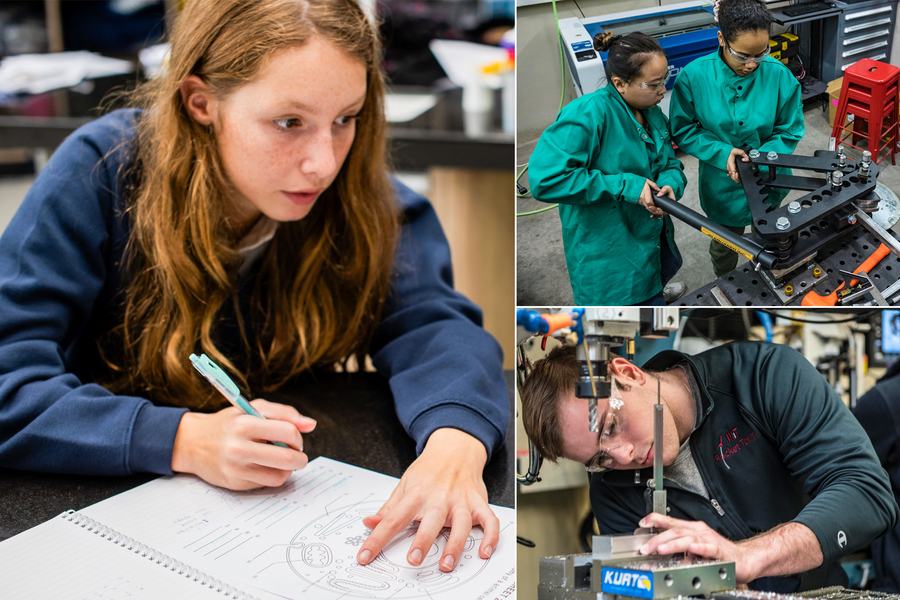
The third area centers on designing, making, and innovating. MIT plans to expand experiential learning through makerspaces, fab labs, design challenges, and sustainability projects. The Fab Foundation already supports learners through 300 U.S. fab labs.
MIT sees the initiative as both an education and workforce effort. By combining scalable resources with mentoring and community partnerships, MIT for America aims to broaden access to STEM and AI skills while helping students participate more effectively in an economy increasingly shaped by science and technology.
