

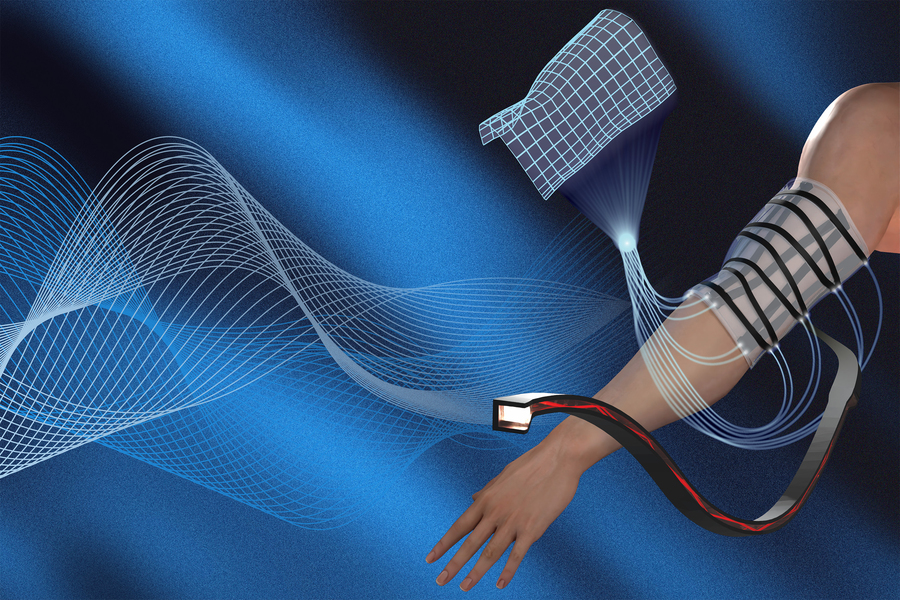
MIT engineers have developed a soft, flexible sheet that can sense its own shape and digitally reconstruct its movements as it bends and twists. Unlike motion-capture systems that rely on rigid sensors attached to clothing, the new technology embeds flexible optical fibers within a stretchable silicone sheet, tells MIT News.
The fibers are made from transparent rubber surrounded by dark rubber cladding. Researchers intentionally roughened one side of each fiber. As a fiber bends, the rough surface changes how light scatters through it, allowing the system to distinguish both the degree and direction of bending. Multiple fibers arranged in optimized zigzag patterns provide enough information to reconstruct the sheet’s three-dimensional shape.
Each fiber has an LED at one end and a light sensor at the other. An external circuit board gathers the measurements, while an algorithm translates changes in transmitted light into a digital representation of the sheet. During experiments, the virtual model followed the physical sheet almost in real time as researchers folded and twisted it into different configurations.
Tests using 3D-printed molds showed that the reconstructed surface differed from the physical sheet by less than 0.4 centimeters. Existing approaches based on rigid sensors typically produce errors of about 1–2 centimeters. The system also remained functional when some fibers were cut or disconnected because the remaining sensors could still reconstruct the overall shape.
Potential applications include wearable motion-tracking garments for physical therapy, virtual reality, gaming, and teleoperated robots. A sheet wrapped around a patient’s arm or leg, for example, could quantify changes in mobility during rehabilitation.
The researchers now plan to make the fibers substantially thinner and increase their density. This could eventually enable lightweight garments capable of capturing detailed body movements while remaining soft, flexible, and comfortable.
