

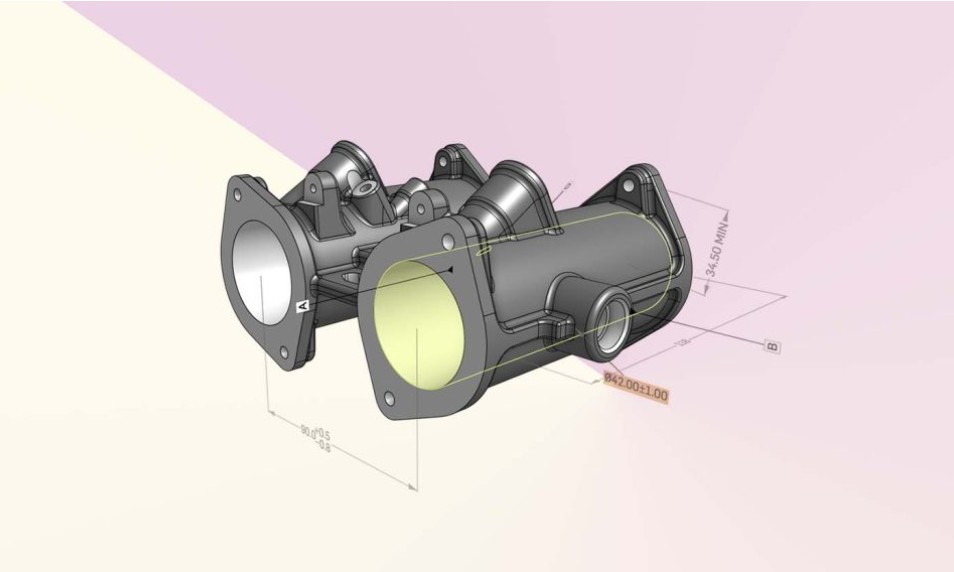
The cloud-native CAD platform Onshape has introduced model-based definition (MBD) capabilities, extending its role from design tool to a more complete digital product definition environment. With this release, engineers can embed product manufacturing information (PMI) directly inside the 3D model, allowing teams to capture dimensions, tolerances, annotations, material specifications, and surface finishes within a single digital artifact, tells Develop 3D.
Traditionally, manufacturing teams rely heavily on 2D drawings to communicate critical product details. Even when a 3D model exists, designers often create additional documentation to specify tolerances, annotations, and inspection requirements. This separation between the model and documentation can introduce interpretation errors and slow collaboration between engineering and manufacturing groups. Onshape’s MBD tools address this issue by integrating these details directly into the model, enabling the 3D geometry to act as the primary reference for design and production.
The system includes standards-compliant annotation tools that communicate design intent within the model environment. Engineers can share models through browser-based links that preserve display settings, section views, and annotations, allowing stakeholders to review manufacturing information without exporting files or installing additional software. Because Onshape is cloud-native, the data becomes immediately accessible across devices and locations, supporting distributed collaboration among design and production teams.
The new MBD capabilities also integrate closely with Onshape’s feature tree and model structure. Product manufacturing information can be linked to specific geometric features, such as sketch dimensions, hole tolerances, or datum references. A dedicated inspection panel organizes and lists these PMI elements, enabling engineers to review and validate the information efficiently while highlighting corresponding features directly in the 3D model.
Additionally, the platform supports future export of this data to standards such as STEP AP242 and to inspection tools used for compliance documentation. By connecting design data with downstream manufacturing and quality workflows, the update helps bridge the gap between engineering design, inspection processes, and production planning.
Overall, the release positions Onshape as a cloud-based platform capable of supporting model-based enterprise practices in which the 3D model becomes the single authoritative source of product information.
