

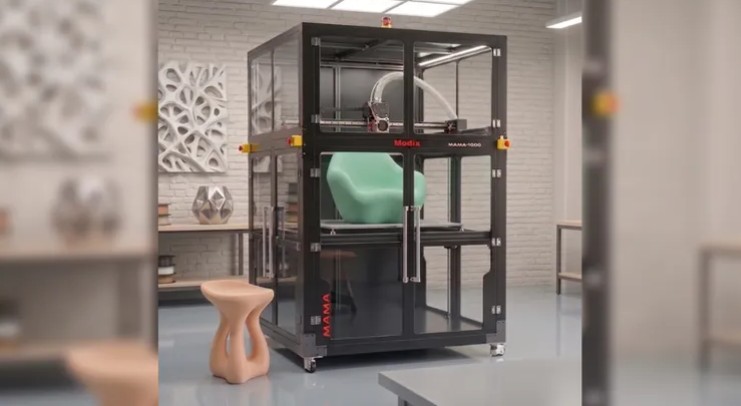
The latest addition to Modix’s portfolio, the MAMA 1000, is designed to address the growing demand for large-scale additive manufacturing. Unveiled as a high-capacity industrial 3D printer, the system combines a one-cubic-meter build volume with rapid material deposition rates, enabling manufacturers to produce large parts more efficiently than many conventional desktop or mid-sized systems, tells Tom’s Hardware.
A defining feature of the MAMA 1000 is its ability to extrude material at speeds reaching up to 3 kilograms per hour. This capability significantly reduces production times for oversized components, prototypes, molds, jigs, fixtures, and functional industrial parts. Large-format printing has traditionally been constrained by lengthy build times, making throughput a critical factor for manufacturers seeking practical production solutions.
The machine’s one-meter-by-one-meter-by-one-meter build chamber provides substantial design freedom. Engineers can fabricate large components in a single print rather than dividing them into smaller sections that require assembly afterward. This approach can reduce labor, improve structural integrity, and simplify production workflows.
Modix has positioned the MAMA 1000 as an industrial-grade platform rather than a hobbyist machine. Its starting price of approximately $35,000 reflects its focus on professional users who require large build volumes and high-output performance. The printer is intended for sectors such as manufacturing, automotive, aerospace, product development, and research, where large-scale prototypes and tooling are frequently needed.
The system also reflects a broader trend within additive manufacturing. As the technology matures, manufacturers are increasingly seeking equipment capable of producing larger parts at higher speeds while maintaining reliability and material flexibility. Large-format extrusion systems are becoming an important segment of the market because they can bridge the gap between prototyping and production.
The MAMA 1000 illustrates this evolution. Rather than focusing solely on precision miniatures or consumer applications, it emphasizes scale, productivity, and industrial utility. For organizations looking to expand their additive manufacturing capabilities, the machine offers a combination of size and throughput that could help accelerate design validation, tooling production, and low-volume manufacturing. Its launch highlights the continuing shift of 3D printing from a prototyping tool toward a more integral role in industrial production workflows.
