

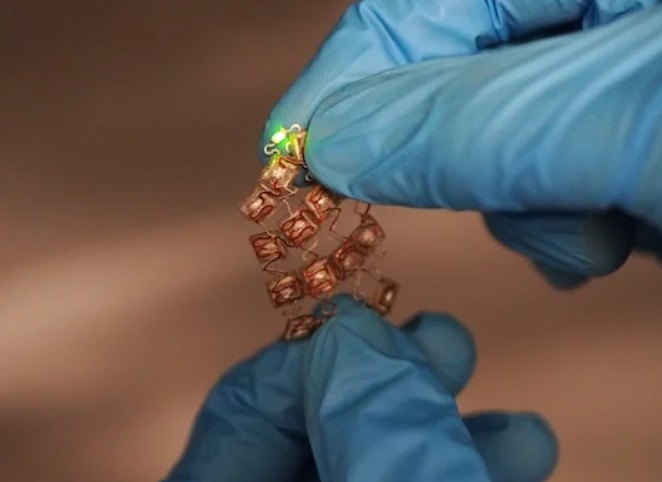
Researchers from Rice University and North Carolina State University have developed a stretchable, moisture-activated battery that generates electricity by extracting water from the surrounding air. The innovation offers a lightweight, environmentally friendly alternative to conventional batteries for wearable electronics, miniature robots, and Internet of Things (IoT) devices. By eliminating toxic liquid electrolytes and activating only when exposed to ambient moisture, the battery combines the advantages of energy harvesting with the reliable output of a traditional battery.
The battery consists of a magnesium anode, a silver/silver chloride cathode, and a cellulose separator infused with lithium chloride salts. When the separator absorbs moisture from the air, the salts dissolve and create an electrolyte that enables electrical current to flow. Because the battery remains dry inside sealed packaging, it has a long shelf life and avoids the leakage and flammability associated with many existing battery technologies. It can operate even in arid environments, making it suitable for a wide range of applications.
To improve flexibility without sacrificing energy density, the researchers drew inspiration from the overlapping scales of a pangolin. Unlike many stretchable batteries that lose capacity when elongated, the bioinspired design minimizes empty space while evenly distributing mechanical stress. Tests showed that the battery maintained performance under bending, twisting, and stretching. The prototype successfully powered a wireless Bluetooth pulse oximeter for up to 30 hours, demonstrating performance comparable to conventional batteries despite its thinner, lighter, and biodegradable construction.
The team also integrated a unique security feature into the technology. A compartment containing dry aluminum and iodine powder remains isolated until tampering breaks the seal. Moisture then triggers a rapid chemical reaction that destroys the electronic device within minutes, protecting sensitive information. Researchers demonstrated this capability using a wireless surveillance sensor, whose electronics were completely destroyed after activation. The study suggests that moisture-activated batteries could support a new generation of sustainable, flexible electronics while providing enhanced security for specialized applications ranging from wearable health monitors to covert sensing devices.
