

Nashville calls itself Music City. Motive is here to make music for your ears — if you are a fleet manager. You see, Motive makes hardware and software for commercial vehicles, whether they are trucks, vans or construction vehicles.
Motive is in the business of fleet management, not a subject engineers would normally concern themselves with — except that the way the company has aggressively applied in transportation could inspire the design and engineering software vendors, which have, so far, taken a more cautious approach.
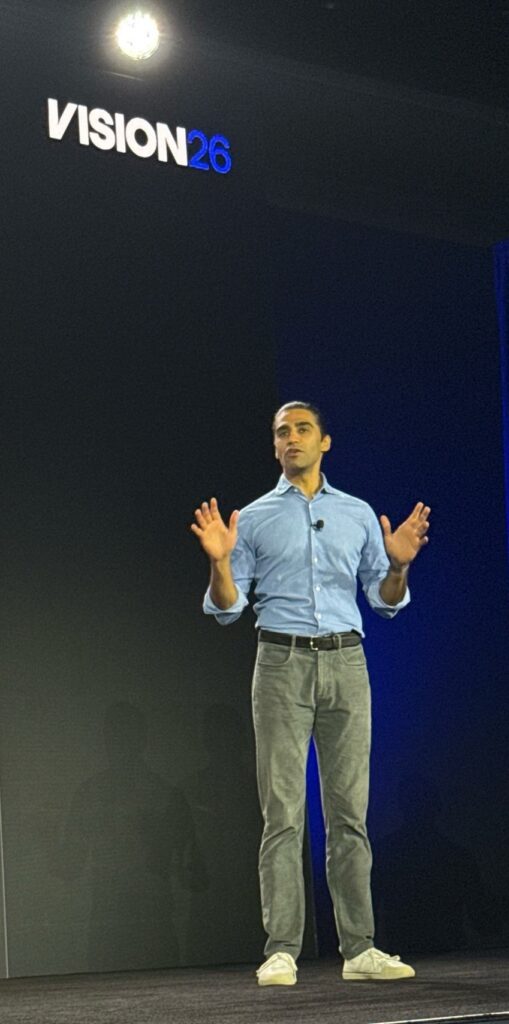
In choosing Nashville, Motive is not alone. I’m going to more conferences in Nashville than Las Vegas these days. Vision 26 is only Motive’s third annual customer summit, but so well is it run and managed that it feels like they have been doing it for decades. More than a thousand fleet managers, safety directors, and operations leaders packed the JW Marriott on the late days of May 27 to hear what the San Francisco company had been up to.
Motive-ational Speakers
The hour-long keynote is dense with product announcements, customer testimonials, and live demos. The intended takeaway from Motive to fleet operators: we got you, bro.
It seemed to be working from where I sat (front row). I heard applause behind me after many a product announcement or improvement.
Shoaib opens the conference with a keynote. Motive will make fleet managers into heroes by saving their companies’ money. A $3.4 million in annual savings for a 1,000-vehicle fleet is typical. Motive has delivered 250,000 AI “coaching sessions,” Motive-speak for a soft scolding to drivers. Motive estimates 170,000 accidents were avoided with AI-assisted accident avoidance (more on that later).
The problems transportation is the fragmentation and manual work according to Motive. Apps don’t talk to each other. Drivers and fleet managers spend too much time doing too few things. Motive’s AI agents can do more tasks faster and more consistently. AI agents don’t miss a wink (that could be driver starting to nod off), they don’t forget and they work around the clock without complaint.
The solutions, Shoaib said, are integration and automation. He called them Motive’s two North stars.
The Hardware Gets Smarter
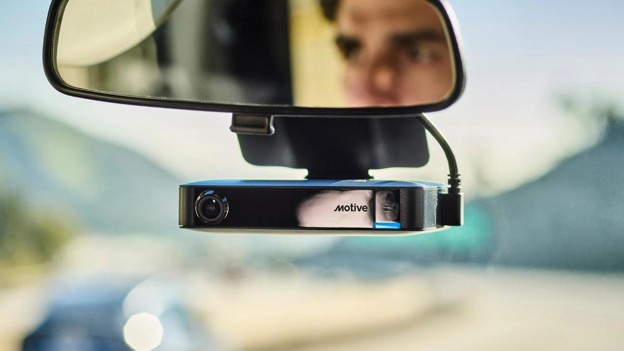
We see the AI Dashcam Plus — a device Motive launched commercially in January 2026, and which the company is now actively pushing as a replacement for the separate telematics box and dashcam combination that has been the industry standard. It makes sense: one device instead of two, faster installation, one point of failure instead of two and a form factor that doesn’t block as much of the driver’s view.
But it’s the view inside the device where the AI magic happens. The AI Dashcam Plus runs on the Qualcomm Dragonwing QCS6490 processor — the same silicon that powers the new AI Omnicam Plus (announced at Vision 26). That chip delivers three times the processing power of competing dashcams, according to Motive, and it runs more than 30 AI models simultaneously on the device. No long and lengthy cloud round-trip required. The AI sees the road, reasons about it, and acts — in the vehicle, in near-real time.
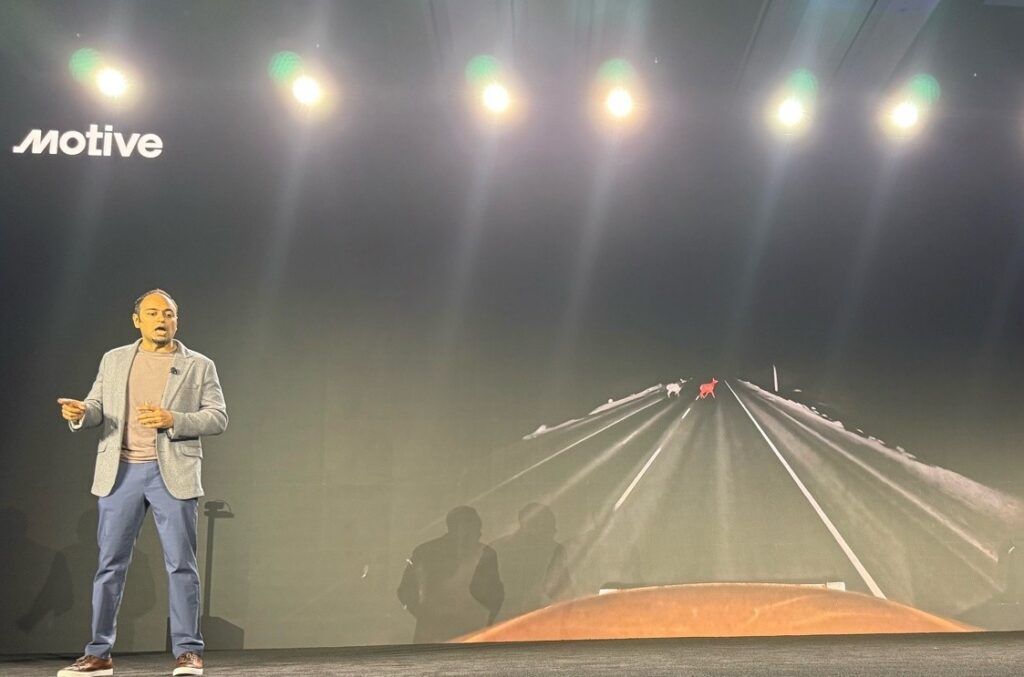
Next was Nihar Gupta, Motive’s VP of Product, took the stage to walk through what that compute makes possible: collision avoidance, for one thing. Coming to the AI Dashcam Plus later this year, Motive’s collision avoidance which is like no other. Traditional systems measure distance frame by frame: how far is that vehicle, how fast are we closing, is the time-to-impact below a threshold? Then it fires off an alert.
Motive’s collision avoidance works differently. Two road-facing cameras — a wide lens and a zoom lens — fuse into a stereo view with depth, the way human eyes do. The Qualcomm processor models the physics of the objects on the screen, identifying and tracking what is moving in real time. Three trajectories are determined with varying likelihood of collision indicated by color. The AI doesn’t wait for a bad outcome, it predicts it. Prediction gives the driver more time to react.
“This isn’t just a better forward collision warning model,” Nihar told the audience. “It’s a new approach to predicting collisions.” The system handles vehicles, cyclists, animals, and pedestrians. In one demo clip, it was pitch black and a deer entered the lane. The dashcam caught it, rendered a possible path that would have put it on collision course with the truck in red. Human vision, Nihar suggested, might not have registered the deer at all in time.
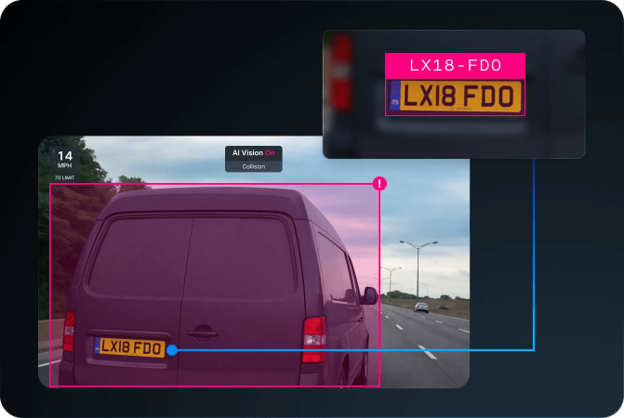
The zoom lens does double duty. Automated License Plate Recognition — ALPR — uses a high-resolution narrow-field camera to capture plates in motion, day or night, rain or snow. The moment a collision is detected, Motive surfaces the plate, make, model, and color automatically. Nearly one in seven collisions on U.S. roads is a hit and run, Nihar noted. That number is climbing. With ALPR, fleet managers can help identify hit-and-run drivers and save their own fleet from getting nicked with uninsured driver claims.
One more addition to the detection suite: AI-powered speed sign detection. Instead of relying on a map database, which can lag posted speed limits by days or weeks. The AI Dashcam Plus reads the signs directly off the road. With the older system, a driver could have gotten a black mark for speeding because the map database still showed a lower speed limit.
360 Degrees of View
The AI Omnicam Plus is a 360-degree camera system designed to bring the AI-powered awareness of the Dashcam Plus to everything around the vehicle — not just the road ahead.
The system supports four HD camera inputs, built-in LTE so it can operate standalone, and a live in-cab display that gives drivers a real-time view of their surroundings. Left and right views activate automatically with turn signals. The rear view comes up when reversing. And the AI continuously monitors for pedestrians and cyclists in risk zones, delivering audio and visual alerts when someone is too close or approaching too quickly.
Shoaib pointed out 47 percent of accidents involve sideswipes and rear-end collisions with contact made outside a driver’s natural line of sight. Omnicam Plus is designed specifically for that problem.
Taken together, the AI Dashcam Plus and AI Omnicam Plus represent Motive’s argument that integration needs to extend into hardware, not just software. The telematics box, the front dashcam, the side cameras, the in-cab display — they no longer need to be four products from four vendors, generating four data streams that someone has to reconcile. One platform, one processor, one bill.
Coaching Not Scolding
Dinesh Coca, Motive’s product director for workforce management, gave more details about Motive’s AI Coach that delivered 250,000 personalized “coaching sessions,” which are automatically delivered without human intervention. No fleet manager has to schedule an appointment or make the call. Motive claims that drivers who actively engage with their coaching sessions show an eight-times greater safety score improvement, and a 50 percent drop in total safety events. Cell phone use — notorious, pervasive and proven to be hardest to stop, dropped to zero in many cases.
One large infrastructure fleet (not identified) saw every unsafe behavior category fall by more than two-thirds.
With the AI Coach, fleet managers can now choose which behaviors and severity levels trigger coaching, how frequently it is delivered, and which coaching avatar — a human face and voice — delivers it to which driver group or region. The company has expanded its avatar library to give programs a more authentic feel. Fleets can also upload their own policies directly, so the coaching language reflects their own rules, not Motive’s generic defaults.
Positive reinforcement has been added. When a driver has a clean week with no events, AI Coach gives the driver a pat on the back, so to speak.
Driver Rewards extends the motivation logic into financial incentives. Fleet managers can set up challenges — reduced idling, improved safety scores, for example — and Motive tracks performance and identifies winners in real time. Through the Motive Card (a company-branded MasterCard), the winners receive cash rewards deposited directly to their digital wallet.
Performance Hub ties it together: a control tower for coaching, training, and rewards, with a coaching score that tells managers whether the program is actually working — specifically, whether behaviors stop after coaching is delivered. Motive even surfaces which supervisors are slow to coach. Rick, a fictional composite Coca used onstage, had a four-day delay in delivering feedback. His drivers were repeating the same mistakes before Rick even had a chance to address the first ones. Performance Hub flags that sort of thing.
Road Atlas

Emily Parsons introduced Atlas, Motive’s new AI assistant, to the Vision 26 audience. Atlas is built into and accessible from every part of the platform, aware of fleet data, driver history, active workflows, and capable of doing executing tasks, not just answering questions like your normal chatbot.
Emily walked us through a fleet manager’s Monday. Coffee in hand, team about to roll out the fleet, he asks Atlas “What do I need to be aware of this morning?” And before any truck leaves the yard. Atlas scans safety, compliance, operations, and fuel simultaneously and provides a brief briefing — not a densely packed dashboard, not a data dump, but a true briefing. It has surfaced the specific issue that needs immediate attention. Atlas has determined that there has been a spike in phone use behind the wheel in a group of drivers. Then Atlas acts. It identifies the most offending drivers, reviews each one’s event history and safety score and drafts a personalized message for each of them — all in roughly ten seconds. This would have taken the fleet manager all morning. With Atlas, the coffee is still warm.
MCP integration (Model Context Protocol) is mentioned and we are told it will be put in use. Motive is use MCP to connect to Claude, ChatGPT and possibly Gemini. Fleet data flows out from the MCP connection.
Motive explains one way the data could be used. A safety manager can ask Claude to pull a year’s worth of Motive data, particularly how safe the drivers have been, to bolster their insurance premium reduction negotiation.
The report is created in a jiffy. Alas will comb through safety records, compare them to industry benchmarks and pull up the insurance contract — in a single prompt. One report, three sources, started and completed in the hour before the renewal meeting starts. No all-nighter for one lucky fleet manager.
The voice version of Atlas resides in the AI Dashcam Plus itself. Parsons demonstrated it from the driver’s seat: voice sign-in by name, hands-free, no PIN. Route status on demand. A recommended fuel stop through Motive’s Discount Network, optimized by price and proximity. A traffic delay was flagged and a message sent to dispatch, without the driver touching anything. It is, as Parsons put it, not a voice command — it’s a partner on the road.
Atlas, the MCP integration, and the voice assistant are expected to ship this summer.
Hair Triggers
Sean Santschi, Head of Product Development: AI Applications and Customer Platform, introduced Automations as a hedge against the $46 billion he estimates is lost annually across the U.S. from just 3 common problems:
- Downtime from fault codes nobody acted on fast enough.
- Compliance violations from missed DVIRs (Driver Vehicle Inspection Reports) and hours-of-service infractions.
- Every minute the engine is idling is money lost — at a higher rate than ever with today’s fuel prices.
Automations is, at its core, an if-this-then-that engine for fleet managers. A trigger could be a critical fault code, a construction vehicle leaving a geofenced zone or a new driver is hired, he starts tomorrow. Motive’s automations fire immediately. The new driver is immediately issued a company card that shows up in his e-wallet. Motive can do that automatically without waiting for a manager to notice and respond. The fleet manager need not learn how to code because the automations are created using natural language prompts.
Fault code management and response is enhanced with Motive’s AI. A fault code is hardly self-explanatory. You have to be a detective to interpret them. They are just cryptic numbers and letters. Fleet mechanics are left to interpret the output fault codes generated. With Motive AI, every fault code comes with a plain-language description of what is happening inside the vehicle, a severity rating, and a recommended action. An automation can take it from there, detecting the fault, messaging the driver that the truck will need to be serviced at the end of his shift. This way, a hypothetical $200 thermostat repair doesn’t become a $20,000 roadside breakdown.
Tucker Miller brought the concept to life. Tucker manages operations for XKIG — the combined entity formed from Xylem Tree Experts and Kendall Vegetation Services, making it one of the largest utility vegetation management companies in the country, operating roughly 8,000 pieces of equipment across 44 states. XKIG’s work is exactly the kind that puts vehicles in unusual places at unusual times: right-of-way clearing, wildfire prevention, utility line management across terrain that could too easily create a delayed response.
XKIG created geofenced wildfire risk zones — boundaries that move as fire conditions change, sometimes hourly, with an automation. When a vehicle enters a fire risk zone, Atlas delivers an immediate voice alert to the driver through the AI Dashcam Plus, with zone-specific safety protocols. No smoking. Clear brush from under chippers. No open flames. Policies, the driver may know what to do when they are in a fire risk zone, but may not know when they have entered one — it may not have been an active risk when they started the shift.
“It can change sporadically,” Tucker said. No matter, the automation handles it.
The fatigue detection scenario Sean ran showed Atlas detecting signs of fatigue in a driver, initiating an automated verbal check-in with the driver and gently instructing the driver to find a safe place to pull over. Atlas stays on the line until they are parked. Motive gives the grim stats: 100,000 accidents and 800 fatalities every year in the U.S. attributable to overtired drivers.
More about new driver onboarding. The moment a driver is added to Motive, a company-branded MasterCard is created, assigned, and loaded with spending policies automatically. A digital card is delivered to the driver’s phone the same day they start. No waiting for a physical card to ship. No driver is being paid to wait days to drive because his credit card has not arrived. If a card is lost or stolen, replacement is instant. No driver is left stranded with no way to pay for fuel.
To underscore the point, Sean offered to give every attendee in the room a $50 digital Motive Card with a QR code that was on the screen too briefly. Not everyone was able to take advantage of the offer.
You Missed It. AI Did Not.
Shoaib closed the keynote with AI Vision which is meant to reduce the work burden of drivers and operators on the road or on a site.
An example from the waste industry followed: an overfilled dumpster. Every overflowing container is a billable event for the company but extra work for the operator, who has to to notice the overflow, stop, pull out a tablet, take a photo and log the event. Most of the time, that doesn’t happen, says Shoaib.
Motive trained a custom AI model to detect overfilled containers with near-perfect precision. The system automatically detects a pickup, checks whether the container is overflowing, and generates an overage event with visual proof — no worker action required. The result: ten times more overage events captured compared to a human operator. For a 100-truck waste fleet, that could be millions of dollars in additional annual revenue.
More examples of AI Vision: recycling contamination detection, vegetation overgrowth for utility customers, potholes and downed street signs for public sector fleets, worksite safety monitoring for construction and oil and gas. The pattern is the same in every case. Something is happening in the field. Capturing it today requires a human to notice it and manually document it. It doesn’t always happen with human operators. With AI Vision, it happens every time.
Where is Motive Coming From?
Motive aims to do for fleet operations what Salesforce did for sales or what ServiceNow did for IT: building a system indispensable because it creates the data, stores it, processes it, gets insights from it and acts on it. The hardware captures the data. The platform stores and structures it. The AI acts on it. The integrations extend it into the tools people already use.
Motive is the 2nd name for the company that started in 2013 as KeepTruckin with an electronic logging app for truck drivers. Use of ELDs (electronic logging devices) became law for all commercial trucks in 2015. The company expanded into AI-powered dashcams, GPS tracking and spend management software and grew to have nearly 100,000 customers across trucking, construction, oil and gas, and manufacturing. The name was changed to Motive in 2022 because it had grown beyond trucking, explains cofounder and CEO, Shoaib Makani. We think it was because he got tired of explaining how the San Francisco company had nothing to do with The Grateful Dead.
Motive filed for an IPO in December 2025 — NYSE symbol MTVE.
Motive claims to have come back to Nashville with a solution for every problem they heard of at last year’s conference. This was my first Motive conference and my introduction to fleet management, so I can’t confirm that. To me, it seems as if they have also added solutions custom
