

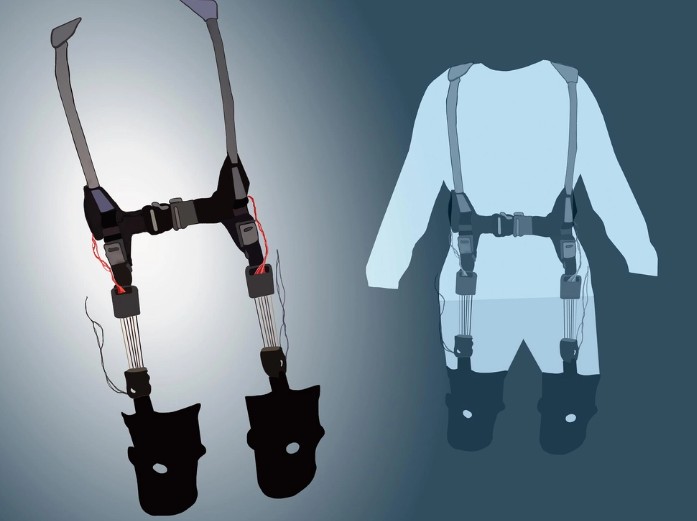
Researchers in China have developed a lightweight, motor-free soft exoskeleton that helps people walk more efficiently using artificial muscles instead of conventional electric motors. Reported in IEEE Spectrum, the wearable device is powered by advanced dielectric elastomer actuators, flexible polymer materials that contract and expand when exposed to an electric field. By replacing heavy motors with these artificial muscles, the exoskeleton provides effective hip assistance while remaining lightweight, comfortable, and less restrictive than traditional powered systems.
Soft exoskeletons have attracted growing interest because they support natural movement without the rigid frames used in conventional wearable robots. However, most existing designs still rely on bulky electric motors or pneumatic systems that add weight and limit mobility. The research team, led by Wei Yu of Hebei University of Technology, addressed this challenge by creating a new dielectric elastomer material that combines high electrical responsiveness with improved mechanical strength. They achieved this by incorporating highly polar compounds that enhance both the material’s durability and its ability to respond efficiently to applied voltage.
The researchers rolled thin films of the material into cylindrical fibers measuring as little as 850 micrometers in diameter. Individual fibers only 1.95 millimeters wide were capable of lifting more than 400 grams, over 1,300 times their own weight. Compared with previous dielectric elastomer artificial muscles, the new fibers are thinner, longer, and deliver nearly 10 times greater output. Multiple fibers can also be combined into modular bundles, allowing engineers to scale the system for different applications.
To demonstrate the technology, the team integrated two 10-fiber bundles weighing just 6 grams into a soft hip exoskeleton. During walking, the artificial muscles stretch as the leg extends, storing elastic energy that is released to assist the forward swing of the leg. Laboratory tests showed that the system reduced the metabolic energy required for walking at 4 kilometers per hour by an average of 13.9%, outperforming most previously reported hip-assistive soft exoskeletons.
Although the results are promising, the researchers emphasize that additional work is needed before the technology is ready for everyday use. Future studies will evaluate long-term durability under real-world conditions, including continuous movement, perspiration, and temperature changes. Another important challenge is reducing the operating voltage, which currently exceeds 1,000 volts. If these hurdles are overcome, motor-free artificial muscle technology could lead to lighter, more practical exoskeletons for rehabilitation, mobility assistance, and industrial applications.
