

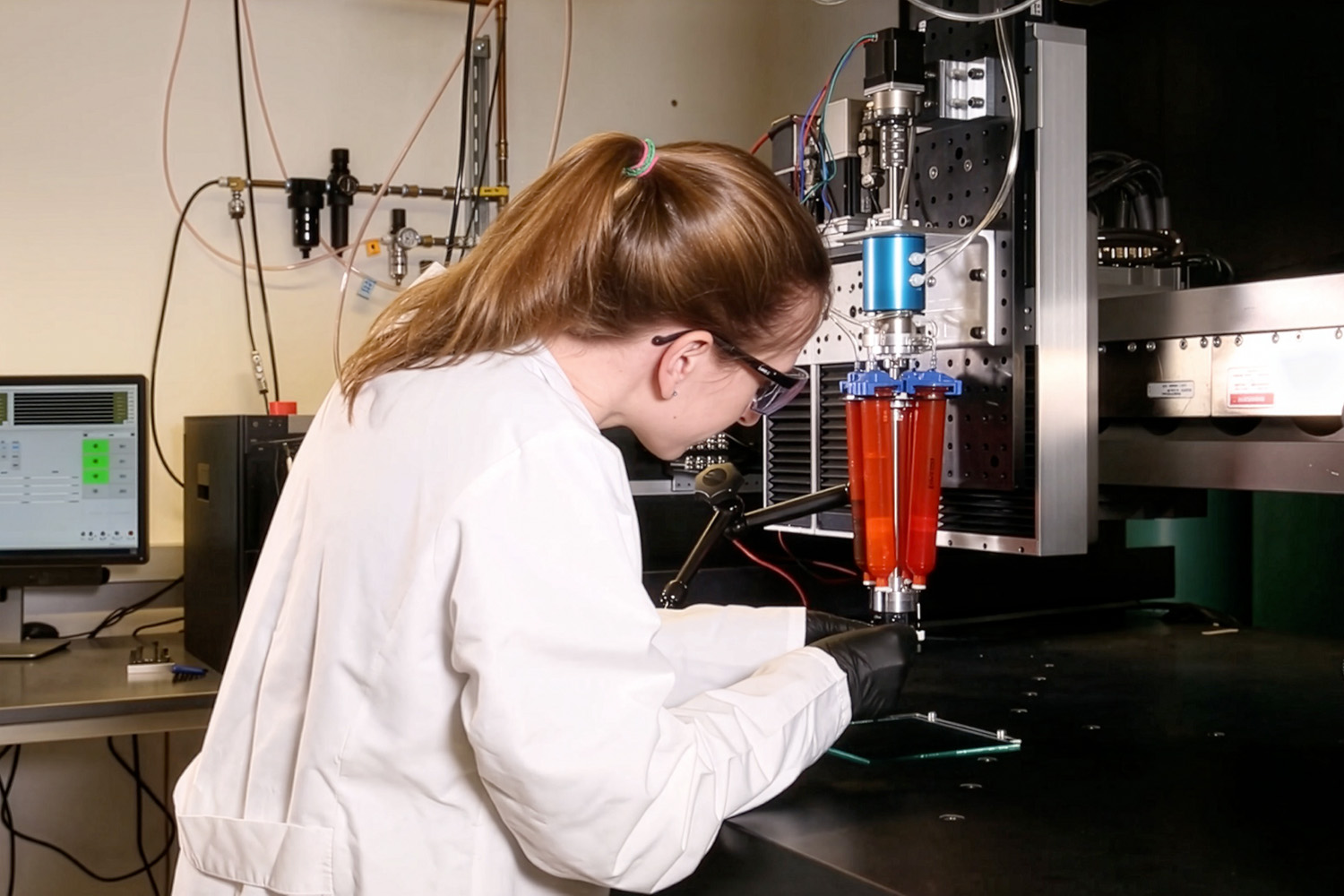
Stanford University researcher Natalie Larson is advancing multimaterial 3D printing to create objects that combine different materials, properties, and functions within a single structure. Her lab focuses on controlling materials at extremely small scales, opening possibilities across health care, transportation, aerospace, agriculture, robotics, and other fields, tells Stanford Report.
A key part of Larson’s research is subvoxel printing, which provides precise control over multiple materials within an extruded filament. One application is cultivated meat. Larson and collaborators are developing a scalable bioprinting process that simultaneously deposits muscle and fat bio-inks along with sacrificial materials. These sacrificial inks create channels for delivering nutrients as cells mature, potentially enabling thick, steak-like cultivated meat with more realistic structures and textures.
Multimaterial printing could also improve soft robots. Unlike rigid machines, soft robots can interact more safely with delicate objects and biological tissues. Larson’s team aims to print multifunctional materials containing embedded sensors and actuators, giving robots capabilities similar to human fingertips when handling objects such as soft fruit.
Another project explores structural battery composites for transportation. Working with Stanford researcher Adam Boies, Larson’s lab is investigating printed components that could simultaneously store energy and carry mechanical loads. Such materials could replace some conventional carbon-fiber structures, reducing vehicle weight and improving overall efficiency.
Larson also sees sustainability benefits in additive manufacturing. Printing customized parts when and where they are needed could reduce molds, inventories, shipping, material waste, and energy consumption. Lightweight printed geometries could also improve aircraft fuel efficiency.
Future research will focus on printers offering greater subvoxel control, helically structured metamaterials and antennas, and 4D imaging combined with computer vision. By automating multimaterial printing and reducing calibration failures, Larson’s team ultimately hopes to enable new classes of functional and living materials that conventional manufacturing cannot produce.
