

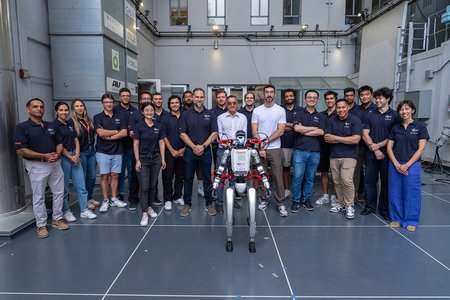
Caltech’s Research Impact page reports a new demonstration by Caltech’s Center for Autonomous Systems and Technologies (CAST) and the Technology Innovation Institute (TII) in Abu Dhabi. They aim to create a robot system that can adapt across locomotion modes, such as walking, flying, and driving, to respond flexibly in challenging environments.
The result is the X1 system, achieved over a three-year collaboration. The design integrates a humanoid robot (modified from a Unitree G1 platform) that carries a morphing robot called M4 as a backpack. In operation, the humanoid can walk to a launch point, deploy M4, which then flies, lands, and transforms into a wheeled vehicle to continue its path, even crossing water and other obstacles.
In a campus demonstration at Caltech, the humanoid walked through corridors, bent forward to release the M4, and allowed it to fly over obstacles and later switch to driving mode. When it encountered the campus’s pond, the system seamlessly switched back to flight to reach the destination. The humanoid and M4 later reunited at the target location.
Technical integration spans sensors (LiDAR, cameras, range finders), onboard autonomy and compute, as well as motion control. TII contributes secure flight controllers and autonomy stacks; Caltech contributes locomotion and control theory. The teams emphasize that X1’s locomotion is not just preprogrammed mimicry of human motion, but physics-based modeling guided by control algorithms that adapt in real time.
Beyond the demonstration, the collaborators see broader applications in search and rescue, disaster response, and reconnaissance, any mission where a robot must navigate between ground, air, and surface modes without human intervention. Safety, reliability, and trust are key challenges they plan to tackle going forward.
The X1 project presents a promising path toward unified multirobot systems able to operate fluidly across terrains. It’s an early but bold step in robotics toward more capable, resilient agents for real-world missions.
