

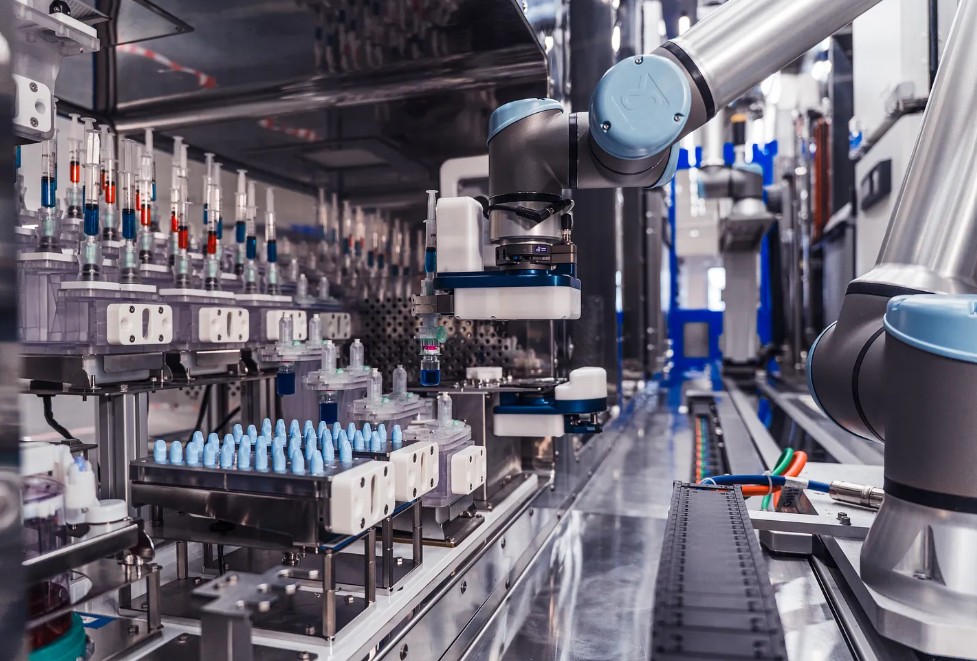
Artificial intelligence is accelerating drug discovery, but producing increasingly complex medicines remains a major bottleneck. Strange Ventures sees Multiply Labs as a company addressing this manufacturing challenge by bringing industrial robotics into advanced biopharmaceutical production.
Cell therapies illustrate the problem. Skilled operators still perform dozens of sensitive manufacturing steps manually inside cleanrooms, including moving cell bags between instruments, connecting tubing, adding reagents, collecting samples, and counting cells. Errors can be costly because each batch may represent an individual patient’s treatment.
Multiply Labs aims to replace much of this manual work without forcing pharmaceutical manufacturers to redesign established production processes. Its robotic clusters are built around existing instruments, consumables, and workflows. Multiple robotic arms and manufacturing systems operate within a closed environment, handling materials, syringes, bags, transfers, sampling, and other tasks. The company says its technology can automate more than 50 unit operations and increase throughput per square foot by up to 100 times.
This approach is important in pharmaceuticals, where manufacturing methods are tightly validated and regulated. Rather than requiring companies to replace existing infrastructure, Multiply adapts robotics to processes already used in production facilities.
The company has announced collaborations with AstraZeneca, Legend Biotech, and Kyverna Therapeutics, while its systems are being deployed in pharmaceutical manufacturing environments. It is also strengthening its industrial capabilities by combining robotics engineers with experienced manufacturing and supply-chain specialists.
Multiply Labs recently raised $75 million in Series B funding. The capital will support increased robot production and the transition from clinical-stage deployments to commercial manufacturing.
Cell therapy serves as the company’s initial proving ground, but its ambitions extend to other advanced biologic medicines. Strange Ventures argues that as therapies become more personalized and biologically complex, manufacturing capacity could become as strategically important as drug discovery itself.
