

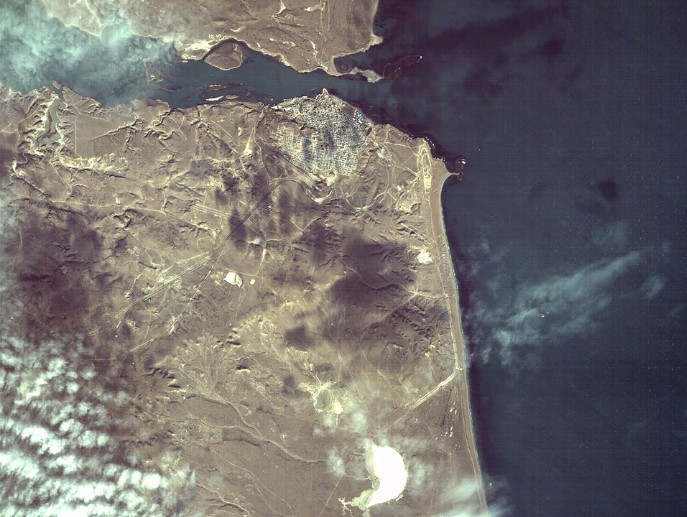
NASA’s Jet Propulsion Laboratory has demonstrated that a large language model can analyze satellite imagery directly in orbit. The experiment used Google’s Gemma 3 within NAVI-Orbital, an agentic software framework running aboard Loft Orbital’s YAM-9 satellite, tells IEEE Spectrum.
NAVI-Orbital uses a compressed 4-bit version of the 4-billion-parameter Gemma 3 model to generate text descriptions of satellite images. Before launch, the system achieved 88% accuracy while classifying a benchmark dataset of 7,960 images, despite receiving no specialized training or fine-tuning for the dataset.
Researchers later conducted live tests over Toulouse, France, and Argentina’s coast. Gemma 3 analyzed images captured by the satellite and answered scripted questions about residential and commercial areas and natural features. The model ran on Nvidia’s Jetson Orin AGX and required only 8 gigabytes of memory, demonstrating that useful AI models can operate on relatively low-power orbital hardware.
Onboard AI could also address one of satellite operations’ biggest limitations: restricted communication bandwidth. Instead of transmitting large raw images to Earth, satellites could use semantic compression to analyze imagery locally and send concise text describing important findings. For applications such as wildfire detection, this could reduce delays caused by downloading and processing imagery on the ground.
The experiment also points toward a new way of interacting with spacecraft. Scientists could change an AI system’s objectives by modifying natural-language prompts instead of rewriting and validating specialized onboard software. NAVI-Orbital remains isolated from YAM-9’s flight controls, so it cannot operate the spacecraft.
NASA ultimately envisions similar AI systems serving as natural-language assistants for astronauts. Although substantial research remains, NAVI-Orbital demonstrates that large language models can operate in space and respond to prompt-based instructions.
