
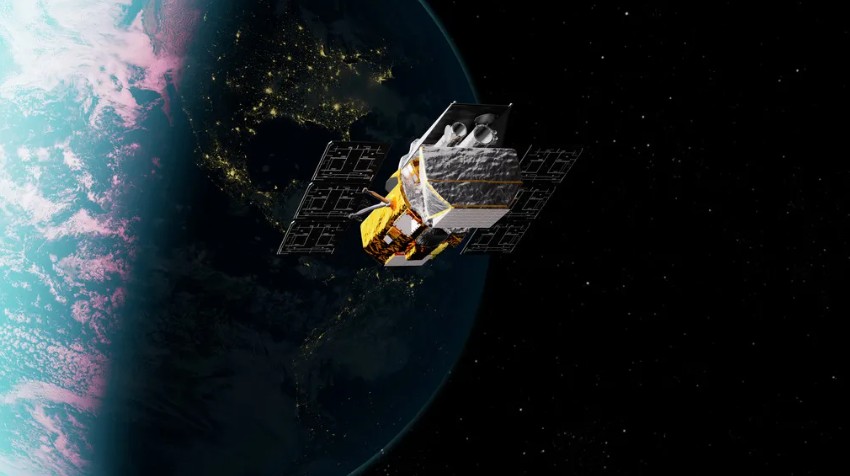
NASA has canceled an ambitious mission to rescue the aging Neil Gehrels Swift Observatory after the spacecraft sent to raise its orbit developed problems with its attitude control system. Swift, launched in 2004 for an original two-year mission, has spent more than two decades studying gamma-ray bursts and other energetic events in the universe, tells Wired.com.
Swift is gradually losing altitude because it lacks a propulsion system powerful enough to significantly raise its orbit. Even hundreds of kilometers above Earth, traces of the atmosphere create drag that slowly pulls satellites downward. Increased solar activity in 2024 heated and expanded Earth’s upper atmosphere, increasing that drag and accelerating Swift’s orbital decay. NASA now expects the telescope to reenter the atmosphere before the end of 2026.
NASA turned to Katalyst Space Technologies for an unusual rescue attempt. The company’s LINK spacecraft was designed to rendezvous with Swift, capture the telescope using robotic arms, and use its thrusters to move the observatory into a higher, safer orbit. LINK launched on July 3, 2026, but soon experienced attitude-control failures that prevented it from maintaining the orientation and stability required for the operation. Engineers spent weeks attempting to restore control.
NASA has now abandoned the capture and orbital-boost portion of the mission. LINK will instead approach Swift to demonstrate rendezvous, navigation, and close-proximity operations. Data gathered during these tests could support future missions designed to repair, reposition, or extend the lives of satellites already in orbit.
NASA Administrator Jared Isaacman described the mission as a calculated risk worth taking despite its failure. Swift was never designed for in-orbit capture or servicing, while LINK was developed and launched under significant time pressure.
Without a successful boost, Swift will continue descending until atmospheric heating and aerodynamic forces destroy much of the observatory during reentry. The exact timing and location remain uncertain, but the mission’s final chapter could still help NASA advance technologies for servicing spacecraft in orbit.
