

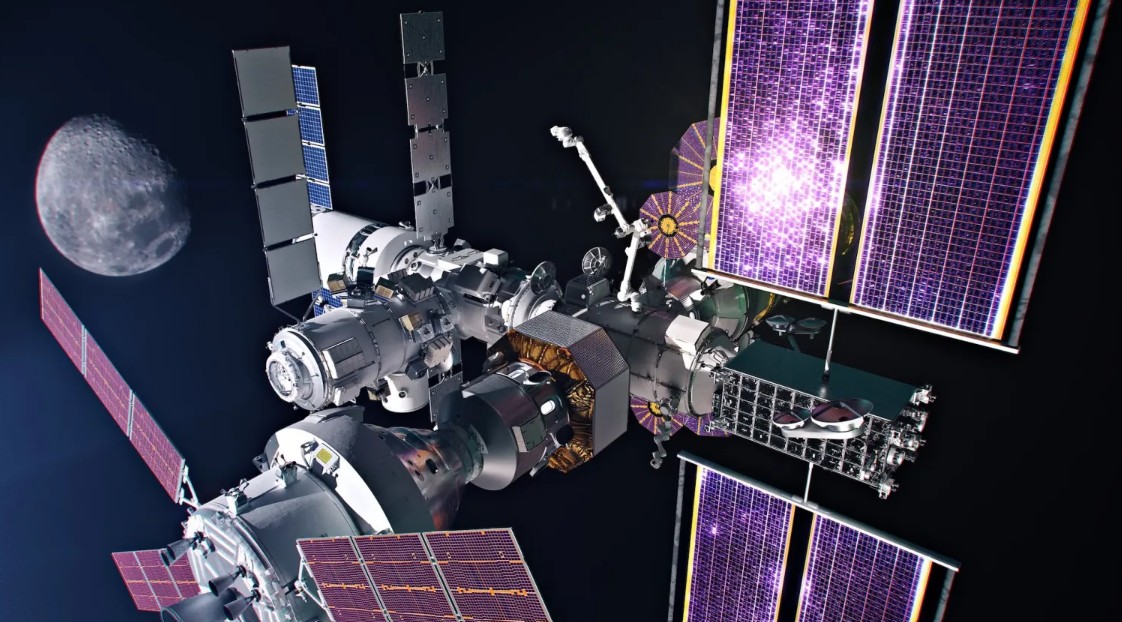
NASA’s planned Gateway space station could eventually become a transportation hub for astronauts, cargo, and scientific equipment traveling to and from the Moon. But increasing lunar activity creates a challenge familiar to airports on Earth: managing multiple vehicles arriving at the same destination. Researchers are already developing strategies to prevent future traffic problems around Gateway, tells Popular Science.
Gateway will operate in a Near Rectilinear Halo Orbit, or NRHO, a highly elongated path around the Moon. The orbit will pass within about 1,000 miles of the lunar north pole before extending roughly 40,000 miles beyond the south pole. Its relative stability, fuel efficiency, and continuous communications with Earth make it useful for lunar operations. However, the gravitational interaction between Earth and the Moon makes managing spacecraft there complex.
The problem becomes harder when several spacecraft approach Gateway simultaneously. Unlike aircraft waiting on a runway, spacecraft cannot simply stop. Instead, they must loiter by maintaining positions relative to specific trajectories while continuously moving through space. This process may last days or weeks and must keep vehicles safely separated without wasting excessive fuel.
Researchers from NASA, Texas A&M University, and Purdue University ran thousands of computer simulations to determine safe loitering strategies. Their models also accounted for potential problems such as navigation errors and thruster failures. The team identified several maneuvers that could keep waiting spacecraft close to their intended locations. These maneuvers can be combined as more vehicles enter the queue.
The resulting arrangement resembles a string of pearls, with spacecraft distributed naturally along the lunar orbit relative to Gateway. Such traffic-management techniques may become essential as lunar missions increase, making orbital coordination as important to sustained Moon exploration as spacecraft and launch systems themselves.
