

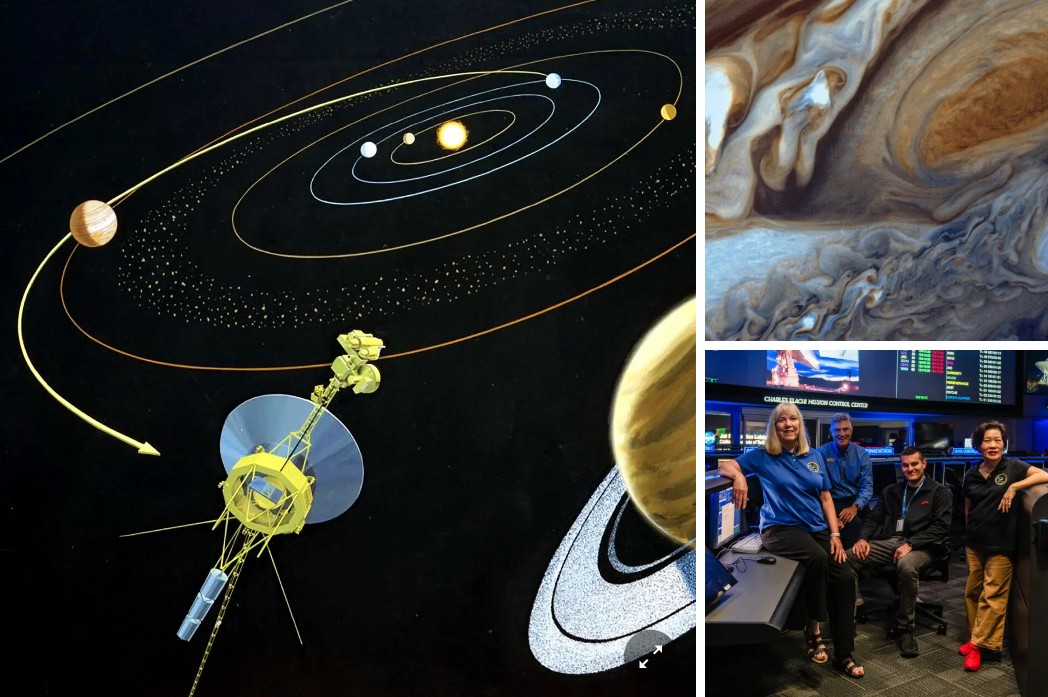
Nearly five decades after their 1977 launches, NASA’s Voyager 1 and Voyager 2 continue traveling through interstellar space while sending valuable scientific data to Earth. Keeping them operational, however, has become increasingly difficult as aging hardware and declining electrical power threaten the historic mission, tells The New York Times (full article available to subscribers).
The spacecraft face three major problems. Residue from silicone components is gradually clogging hydrazine fuel lines, potentially affecting the thrusters that keep their antennas pointed toward Earth. The fuel must also remain warm enough to flow. At the same time, the Voyagers’ plutonium-powered radioisotope thermoelectric generators are producing steadily less electricity. Originally capable of about 470 watts per spacecraft, Voyager 2 now operates on 216 watts, while Voyager 1 has slightly less.
To stretch the remaining energy supply, engineers at NASA’s Jet Propulsion Laboratory devised an ambitious reconfiguration called the Big Bang. Instead of making individual power-saving changes, they adjusted several systems simultaneously, balancing heating requirements against electricity consumption. After nine months of analysis, the team first tested the approach on Voyager 2, which had more available power.
The process unfolded cautiously. In May, engineers tested the new configuration for 40 minutes, followed by a six-hour trial in June to verify temperature predictions. The change became permanent in July. The operation saved about 10 watts, potentially extending Voyager 2’s mission by roughly two years, into 2031. Engineers hope a similar effort will keep Voyager 1 operating until 2030.
Those additional years could prove scientifically valuable. The Voyagers remain humanity’s most distant spacecraft and continue measuring the largely unexplored environment between stars. Scientists are even considering briefly reactivating dormant instruments, although doing so carries risks. For the Voyager team, every watt saved offers another opportunity to study interstellar space before the spacecraft eventually fall silent.
