

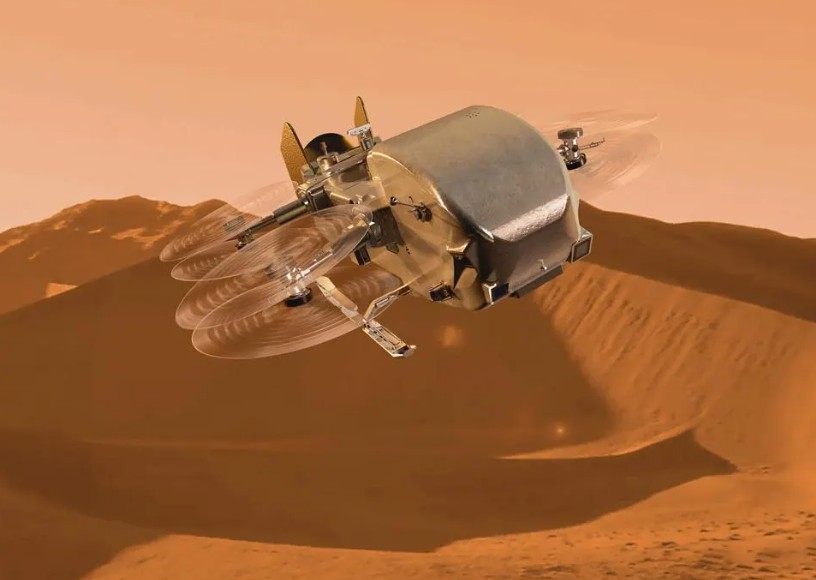
NASA’s Dragonfly mission is moving closer to its planned journey to Titan, Saturn’s largest moon and one of the most intriguing worlds in the solar system. Engineers have completed important structural tests and begun integrating the spacecraft that could transform scientists’ understanding of Titan’s chemistry and habitability, tells Forbes (full article available to subscribers).
Dragonfly is unlike any planetary lander NASA has previously built. The car-sized rotorcraft will use eight rotors to fly between scientifically interesting locations on Titan. The moon’s nitrogen-rich atmosphere is about four times denser than Earth’s, making powered flight particularly suitable for exploring its varied terrain.
Titan is compelling because it shares several surface characteristics with Earth. It has an atmosphere, weather, rain, lakes, shorelines, valleys, mountain ridges, mesas, and dunes. However, its surface liquids are primarily methane and ethane rather than water. Dragonfly will investigate the complex chemistry that occurs in this unusual environment.
The mission is not designed to search directly for extraterrestrial life. Instead, scientists will study prebiotic chemical processes, including chemistry that may resemble conditions that existed on Earth before biology emerged. During its planned 3.3-year mission, Dragonfly will travel between sites and collect samples for analysis.
Development has recently reached a significant milestone. Engineers at the Johns Hopkins Applied Physics Laboratory completed a month of structural testing on Dragonfly’s nearly 13-foot-long fuselage and delivered it ahead of schedule. The frame already incorporates landing skids, supports for its eight rotors, and housing for its nuclear power system.
Dragonfly is scheduled to launch aboard a SpaceX Falcon Heavy from Kennedy Space Center during a window from July 5 to 25, 2028. After its long interplanetary journey, it is expected to reach Titan in 2034. Once there, its ability to fly repeatedly across the surface could give scientists access to multiple geological environments instead of restricting exploration to a single landing site.
