

Hardware FYI uses renewed attention around the Navier-Stokes equations to examine computational fluid dynamics and its practical importance in engineering. The article explains that while mathematicians continue to investigate fundamental questions about these equations, engineers have successfully built decades of simulation work on them.
The Navier-Stokes equations describe fluid motion under pressure, viscosity, and other forces. Computational fluid dynamics, or CFD, converts these equations into a finite set of numerical calculations that computers can solve. Engineers use CFD for applications ranging from airflow through electronics enclosures to exhaust recirculation in data centers.
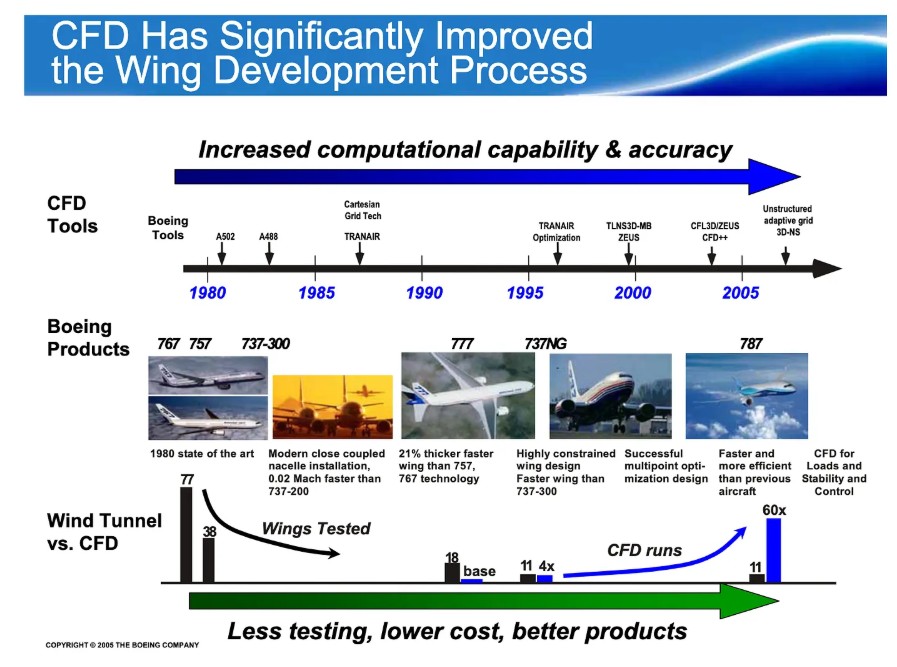
A key example is Boeing’s development of the 787. Hardware FYI points to a 2008 presentation describing how Boeing used CFD to narrow the design space for the aircraft’s wings. As simulation capabilities improved, engineers evaluated designs at both wing and full-aircraft scales. Wind-tunnel testing complemented the simulations, with physical results feeding back into the design process.
The article also addresses why unresolved mathematics surrounding Navier-Stokes does not undermine CFD. The Millennium Prize problem asks whether smooth three-dimensional fluid motion always remains smooth or can develop singularities, where velocities become unbounded in finite time. Engineering simulations do not require a proof that every possible flow remains smooth indefinitely. Instead, CFD solves equations numerically over finite grids and time intervals, then validates predictions against experimental measurements.
The discussion also touches on AI’s growing influence on mathematics. Mathematician Terence Tao raises concerns that opaque AI-generated solutions could diminish the broader intellectual value gained from human attempts to solve difficult mathematical problems.
For engineers, the larger message is practical. Fundamental mathematical uncertainty can coexist with useful engineering models when simulations are carefully bounded, tested, and validated against physical evidence.
