

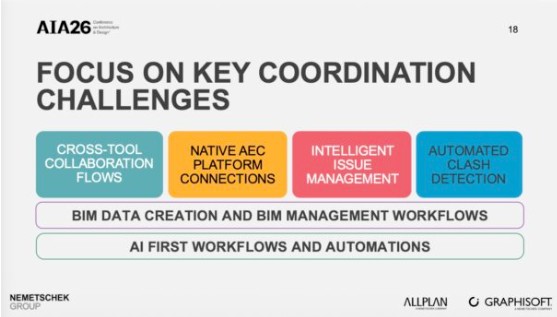
The Nemetschek Group used AIA26 in San Diego to present a unified vision for the future of architecture, engineering, construction, and operations software. Rather than emphasizing individual products, the company focused on an open, interconnected ecosystem where architects and engineers can move data seamlessly between design, collaboration, visualization, and quality assurance tools. The strategy reflects Nemetschek’s commitment to open BIM, interoperability, and AI-powered workflows as alternatives to closed software platforms, tells Architosh.
A central theme was Graphisoft’s Design Intelligence strategy, which combines artificial intelligence with open collaboration technologies. The company demonstrated native BIM connectors that will allow applications such as Archicad, Vectorworks, and Allplan to exchange project data directly instead of relying solely on IFC files. This approach is intended to improve interoperability while preserving each platform’s specialized capabilities. Nemetschek also highlighted expanded collaboration with Autodesk through the new Archicad–Autodesk Forma connection, enabling architects to exchange models and project data more efficiently across competing ecosystems.
The exhibit showcased innovations from several Nemetschek brands. Vectorworks demonstrated tighter integration with Morpholio following its acquisition, creating a workflow that links conceptual sketching with BIM authoring and AI-assisted visualization. Maxon introduced Redshift for Revit and Archicad, extending high-quality real-time rendering across major BIM platforms while maintaining direct connections to Cinema 4D for advanced visualization.
Bluebeam highlighted its latest AI capabilities through Bluebeam Max, which integrates Anthropic’s Claude using the Model Context Protocol (MCP). The platform automates repetitive document workflows, performs intelligent drawing reviews, and identifies inconsistencies in construction documents, illustrating how agentic AI can improve productivity throughout the design review process. Solibri also introduced a redesigned product portfolio with enhanced BIM validation, automated accessibility and sustainability checking, improved IFC support, and new cloud capabilities for quality assurance across the building lifecycle.
Overall, Nemetschek’s presentation emphasized openness rather than software lock-in. By connecting BIM authoring, AI, visualization, cloud collaboration, and quality management across its portfolio, the company is building a platform where information flows more freely throughout the project lifecycle. The strategy positions Nemetschek as a strong advocate for interoperable digital workflows that allow architects and engineers to combine best-of-breed applications while maintaining consistent project data from early design through construction and operations.
