

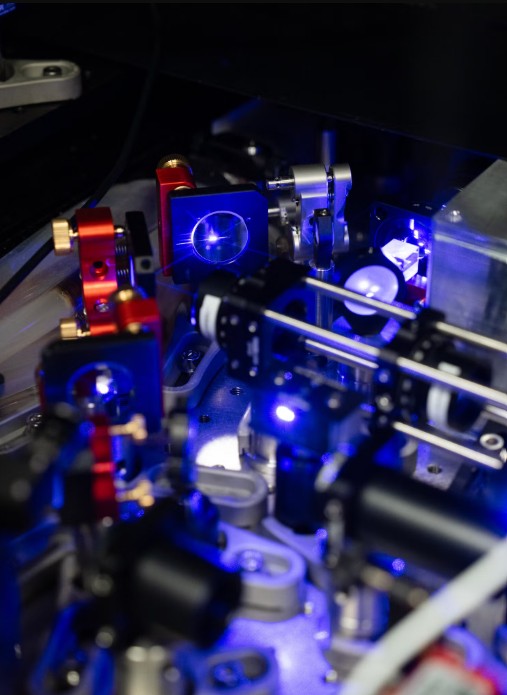
The race to develop a commercially viable quantum computer is accelerating as researchers explore alternative technologies to overcome persistent technical challenges. Google, which has invested heavily in superconducting qubits for more than a decade, has established a second research laboratory in Boulder, Colorado, to investigate neutral atom quantum computing. The move reflects growing confidence in the technology’s potential to simplify error correction and accelerate the development of practical quantum systems, tells The New York Times (full article available to subscribers).
Unlike superconducting qubits, which require cooling metals to temperatures near absolute zero, neutral atom technology uses lasers to trap and manipulate individual atoms inside a vacuum chamber. Each atom functions as a qubit, storing information through quantum superposition. Researchers can manipulate these atoms, control their interactions, and rearrange them to create reconfigurable quantum circuits.
Harvard University physicist Mikhail Lukin and his colleagues have pioneered this approach, using rubidium atoms and exploiting a phenomenon called the Rydberg blockade to facilitate interactions between qubits. Lukin also cofounded QuEra, a startup working to commercialize neutral atom technology.
Error correction remains one of the biggest obstacles to practical quantum computing. Measuring quantum information can disrupt its state, requiring researchers to use additional qubits and exploit quantum entanglement to detect errors without destroying the underlying information. Neutral atoms offer greater flexibility in positioning and controlling qubits, potentially making error correction more efficient.
Meanwhile, superconducting and trapped-ion quantum computing technologies continue to advance. Although no single architecture has emerged as the definitive winner, researchers increasingly believe that viable quantum computers could arrive by the end of the decade or shortly thereafter.
The article also examines the broader implications of quantum computing, including drug discovery, materials development, artificial intelligence, and the potential vulnerability of existing encryption systems. Rather than replacing conventional computers, quantum machines could complement them by solving specialized computational problems and simulating natural phenomena beyond the capabilities of classical systems.
