
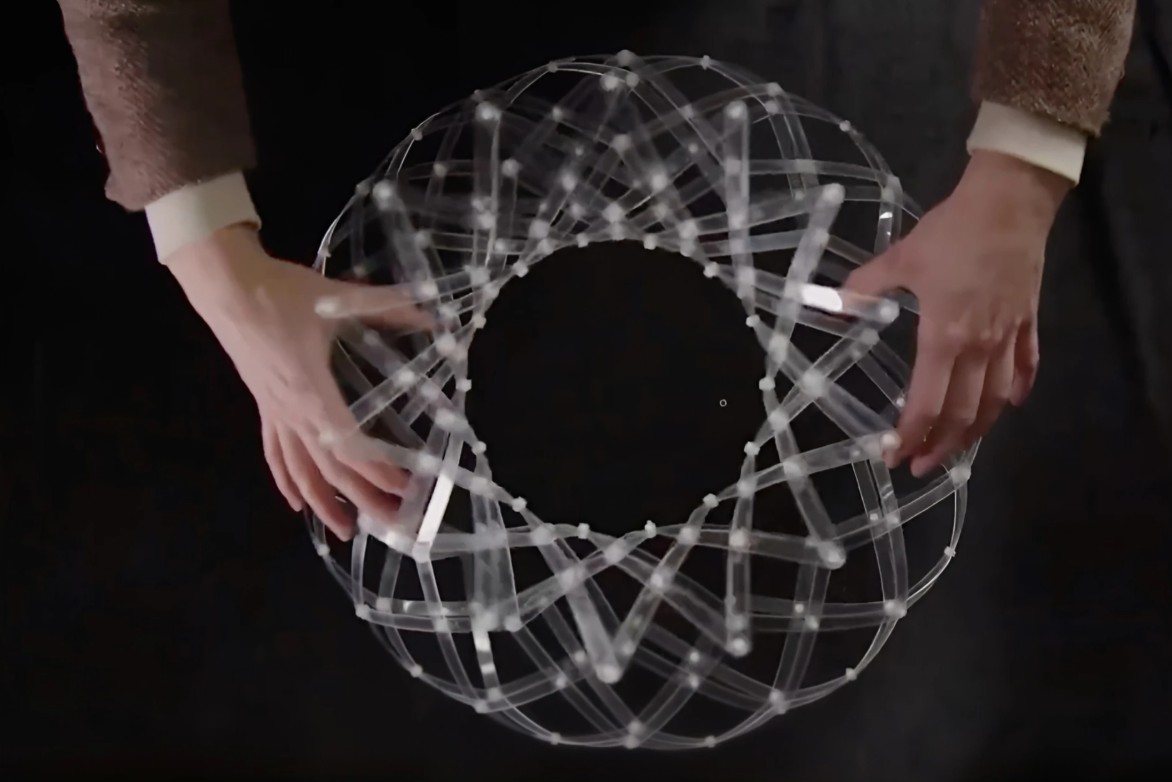
Researchers from Harvard University and the University of Tokyo have developed a computational method for designing complex 3D structures that can expand, collapse, and change shape through networks of rods and scissor-like joints. Inspired by Hoberman spheres as well as the principles behind origami and kirigami, the work explores linkages as another building block for creating transformable structures, tells New Atlas.
The researchers call their designs collapsible scissored surfaces and pantographic lattices. Led by Harvard physics graduate student Noah Toyonaga, the team created an algorithm that grows these structures incrementally. Instead of beginning with a complete shape and determining where every individual joint should go, the method adds connections one at a time according to a small set of geometric parameters.
This local approach allows the overall form of a structure to emerge from relatively simple design rules. Using the algorithm, the researchers explored a broad range of possible mechanisms and computationally designed structures with varying levels of complexity.
The team then fabricated physical examples using multimaterial 3D printers. Demonstrations included helices, toroids, and eggbox-like geometries. One toroidal lattice, for example, can collapse into a compact cylindrical form through the coordinated movement of its interconnected linkages.
The research expands on ideas established through origami and kirigami. Origami uses folds to transform shape, while kirigami combines folding and cutting to increase mobility and functionality. The new approach investigates what becomes possible when mechanical linkages provide the fundamental mechanism for transformation.
Collapsibility can be particularly valuable when available space is limited. Compact structures could reduce the volume required to transport equipment aboard aircraft, submarines, or spacecraft. The underlying design principles may eventually influence deployable habitats, furniture, medical devices, aerospace systems, and other products that need to occupy little space during transportation before expanding into functional forms.
