

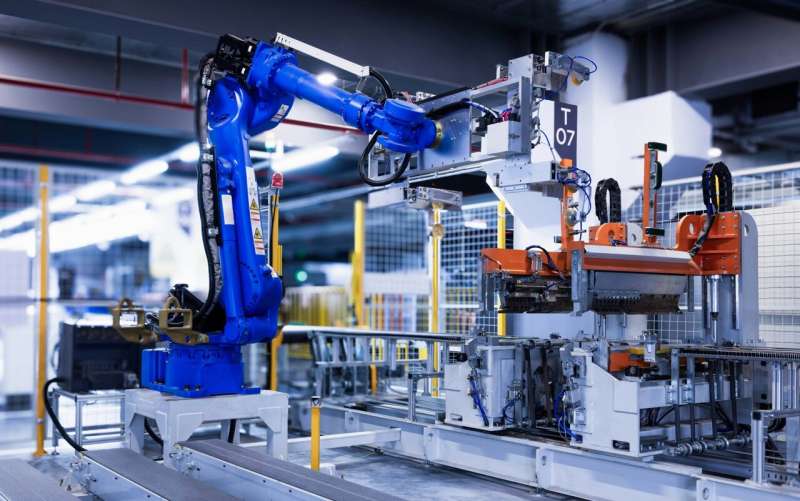
AI coding agents are becoming increasingly capable of writing and revising software, but engineering a working robot requires more than programming. Researchers at Harvard University and Georgia Tech have developed an open-source benchmark called RLE-Bench to measure whether general-purpose AI agents can tackle the broader engineering challenges involved in building robotic systems, tells Tech Xplore.
Led by Harvard professor Na Li and Georgia Tech professor Bo Dai, the research team designed RLE-Bench as a standardized test for an AI robot learning engineer. This multidisciplinary role combines machine learning, robotics, controls, software, and hardware engineering.
The benchmark includes 48 tasks divided into four areas: interactive control, policy development, perception and estimation, and mechanical design. Rather than measuring only an AI system’s ability to generate code, the tasks examine whether it can reason about sensing, dynamics, stability, geometry, hardware limitations, and interactions between software and physical systems.
Agents work within simulated environments where they can generate solutions, execute them, inspect the results, and make improvements. Yet the simulations incorporate physical constraints that expose weaknesses that may not be apparent from code alone.
One task, for example, asks an AI agent to design a universal mobile base capable of supporting different robotic arms and reaching objects at various shelf heights. A design might satisfy the required reach but fail when a payload makes the complete robot unstable. Such examples demonstrate why physical reasoning is critical when AI moves from software into engineering.
RLE-Bench is publicly available as an open-source project, allowing researchers to evaluate AI systems against the same engineering problems and compare their capabilities.
The researchers consider the current benchmark a starting point. Future versions could incorporate additional challenges involving hardware design, system integration, debugging, simulation, safety, and deployment. The broader goal is to determine what AI agents still need to learn before they can function effectively as robot learning engineers.
