

For more than two decades, engineers have faced a fundamental challenge in microwave electronics: dielectric materials could either be electrically tunable or highly energy efficient, but not both. Researchers at Cornell University have now demonstrated a material that combines these seemingly incompatible properties, a breakthrough that could improve wireless communications, radar systems, satellites, and emerging quantum technologies.
The achievement is the result of a 17-year research effort centered on layered crystalline materials known as Ruddlesden-Popper thin films. Most researchers had dismissed these materials because their crystal symmetry suggested they could never provide the electrical tunability required for practical devices. Instead, scientists focused on conventional barium strontium titanate. Cornell’s team, however, continued investigating the unconventional material family despite widespread skepticism.
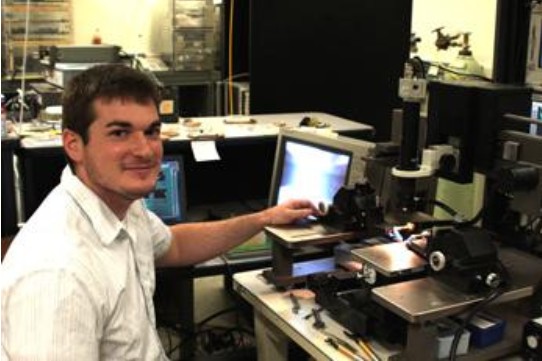
The project gained momentum in 2009 when graduate student Nate Orloff observed unexpected measurement results while characterizing a thin film of strontium titanium oxide. The data suggested that the supposedly untunable material could, in fact, respond to an applied electric field. Although the initial discovery demonstrated tunability, it only worked in a geometry unsuitable for commercial microwave components, prompting researchers to spend more than a decade searching for a practical solution.
The breakthrough came when the team achieved strong out-of-plane tunability while preserving the material’s exceptionally low microwave energy loss, a combination long considered impossible. They also developed advanced metrology techniques that isolated the material’s true electrical behavior from distortions introduced by surrounding test structures, allowing its performance to be accurately measured.
The new dielectric could significantly improve voltage-tunable microwave components such as capacitors, filters, and phase shifters used in wireless communication systems. Lower energy losses translate into greater efficiency, while tunability enables devices to adapt dynamically to changing operating conditions. Beyond telecommunications, the material could benefit radar, satellite electronics, and photonic technologies where precise control of electromagnetic waves is essential.
The researchers believe their work rewrites long-standing assumptions about dielectric materials and opens new directions for microwave engineering. More broadly, the discovery illustrates how persistence, innovative measurement techniques, and interdisciplinary collaboration can overturn accepted scientific limitations and enable electronic components that were once considered unattainable.
