

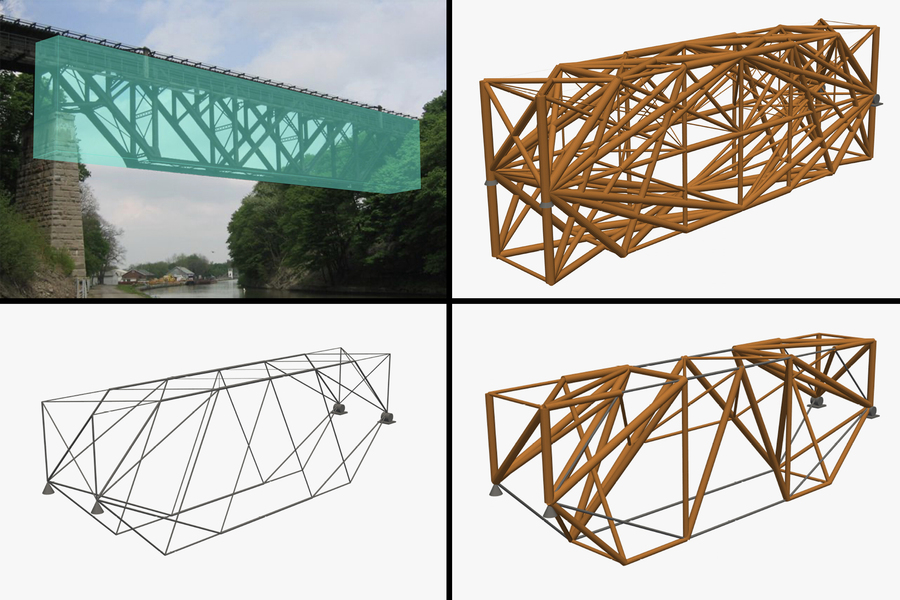
Researchers at the Massachusetts Institute of Technology have developed a computational design framework that could help engineers construct bridges and buildings using significantly less material while making optimized structures practical to build. The approach addresses a longstanding limitation of topology optimization, a technique that generates highly efficient structural forms but often produces designs that are too complex or costly for real-world construction.
The construction industry is responsible for a substantial share of global carbon emissions, with building materials alone accounting for more than 7% of worldwide emissions in 2022. Topology optimization has demonstrated the potential to reduce material usage by as much as 90% in some applications. However, these designs typically feature intricate geometries and numerous complex connections that make fabrication and assembly difficult using conventional construction methods.
The MIT researchers tackled this challenge by incorporating constructability directly into the optimization process. Their framework allows engineers to specify practical constraints before the algorithm generates a design. Users can control factors such as the number of structural members meeting at a single connection, the minimum size of individual components, and the complexity of the final structure. The model also accounts for multiple construction materials and their mechanical properties, enabling the algorithm to distribute loads efficiently while recommending appropriate structural connections.
To demonstrate the system, the researchers designed truss structures using steel, timber, and combinations of multiple materials. The results showed that varying construction constraints significantly influence both structural performance and embodied carbon emissions. By balancing material efficiency with manufacturability, the framework produces designs that are more likely to be adopted by practicing engineers rather than remaining theoretical computer-generated models.
The research represents an important step toward integrating topology optimization into mainstream structural engineering. Instead of treating sustainability and constructability as competing priorities, the new framework considers them simultaneously, allowing designers to optimize material use while respecting real-world construction limitations. As pressure grows to reduce the environmental impact of infrastructure, the approach could enable architects and engineers to deliver bridges and buildings that require fewer resources, generate lower carbon emissions, and remain practical to fabricate and assemble using existing construction techniques.
