

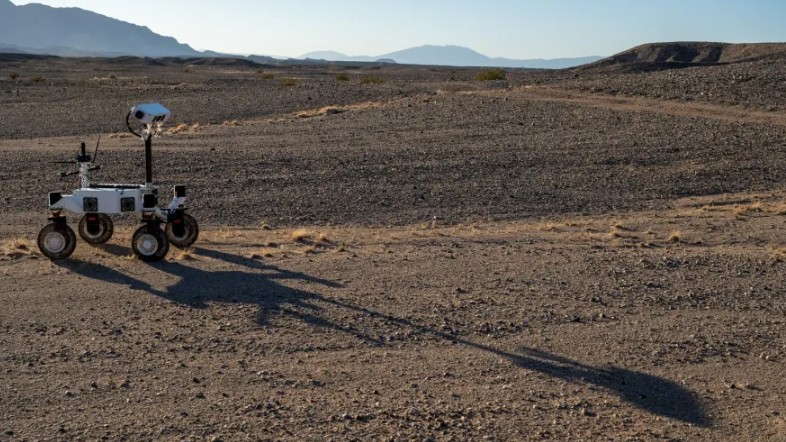
NASA engineers are testing a new rover prototype called ERNEST, short for Exploration Rover for Navigating Extreme Sloped Terrain, to develop technologies that could support future exploration of the Moon and Mars. Built at NASA’s Jet Propulsion Laboratory (JPL), the vehicle serves as a platform for evaluating advanced mobility systems and autonomous navigation capabilities needed to operate in some of the most challenging extraterrestrial environments.
Future missions are expected to target regions with rugged landscapes, steep slopes, loose soil, and large rock formations that exceed the capabilities of current planetary rovers. ERNEST is designed to address these challenges through a flexible suspension system that allows each wheel to move independently. This capability helps the rover maintain stability and traction while traversing difficult terrain, making it a candidate model for future long-range robotic exploration.
The rover is also being used to test increasingly sophisticated autonomous systems. Because communication delays between Earth and distant planetary bodies prevent real-time control, future rovers must make more decisions on their own. NASA is therefore developing software that enables vehicles to identify hazards, select routes, and navigate complex environments with minimal human intervention. These capabilities are expected to improve operational efficiency and expand the amount of terrain that can be explored during a mission.
Field tests in desert environments have demonstrated the rover’s potential. During one trial, ERNEST traveled approximately 16 miles over 37 hours of driving, significantly exceeding the pace of previous rover operations. The tests provide engineers with valuable data on vehicle performance, navigation systems, and long-distance mobility under conditions that resemble those expected on the Moon and Mars.
NASA views ERNEST as part of a broader effort to develop technologies that support sustained exploration beyond Earth. Lessons learned from the project could contribute to future lunar missions under the Artemis program and eventually enable robotic explorers to reach scientifically valuable regions on Mars that remain inaccessible today. By combining advanced mobility, autonomy, and field-tested engineering, ERNEST represents an important step toward more capable planetary exploration systems.
