

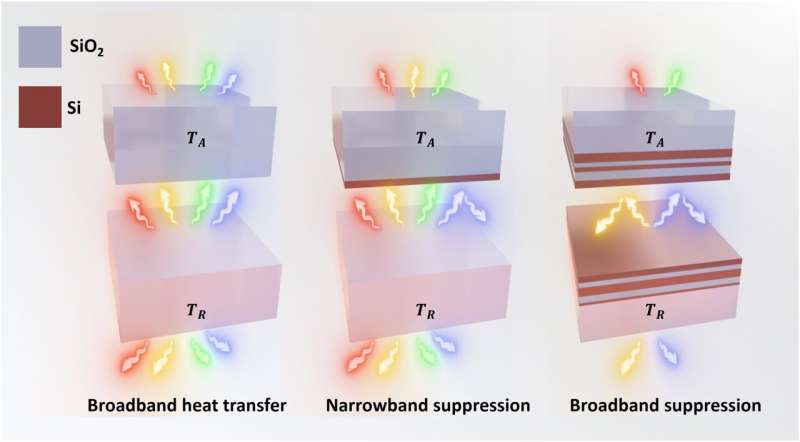
Researchers at the CUNY Advanced Science Research Center and Honeywell Aerospace have developed thin, nonmetallic metasurfaces that significantly reduce radiant heat transfer between closely spaced objects. Laboratory tests showed that the approach reduced thermal radiation emission by more than 80% compared with unstructured surfaces made from the same dielectric materials, tells Tech Xplore.
Objects transfer heat partly through thermal radiation, much of which travels as infrared light. Metallic coatings are commonly used to limit this process because they reflect infrared radiation across a broad range of wavelengths. However, metals conduct electricity, which can interfere with sensitive electronic, optical, and thermoelectric systems. Integrating metallic coatings with other materials can also create engineering challenges.
Nonmetallic photonic coatings avoid electrical conductivity but have traditionally faced another limitation. Thin coatings can strongly suppress radiation across only a narrow wavelength range, while achieving broader coverage generally requires much thicker structures.
The researchers addressed this trade-off by treating two facing surfaces as a coordinated system rather than optimizing each independently. They designed the surfaces so that wavelengths efficiently emitted by one are poorly absorbed by the other, reducing the overall exchange of thermal energy.
Each metasurface contains seven thin layers of nonmetallic dielectric materials arranged as distributed Bragg reflectors. These structures selectively reflect or transmit different wavelengths. By deliberately creating complementary spectral responses between the two surfaces, the researchers achieved broadband heat-transfer suppression while keeping the coatings compact.
The layered structures can also be manufactured using established thin-film deposition processes without requiring complicated nanoscale patterning. Tests showed that the design maintained its performance across a wide temperature range and tolerated small fabrication and design variations.
The technology remains at the proof-of-concept stage, and additional testing is planned. If successfully developed, it could provide a new thermal-control option for electronic devices, infrared sensors, spacecraft components, and other systems where electrically conductive metallic coatings are impractical.
