

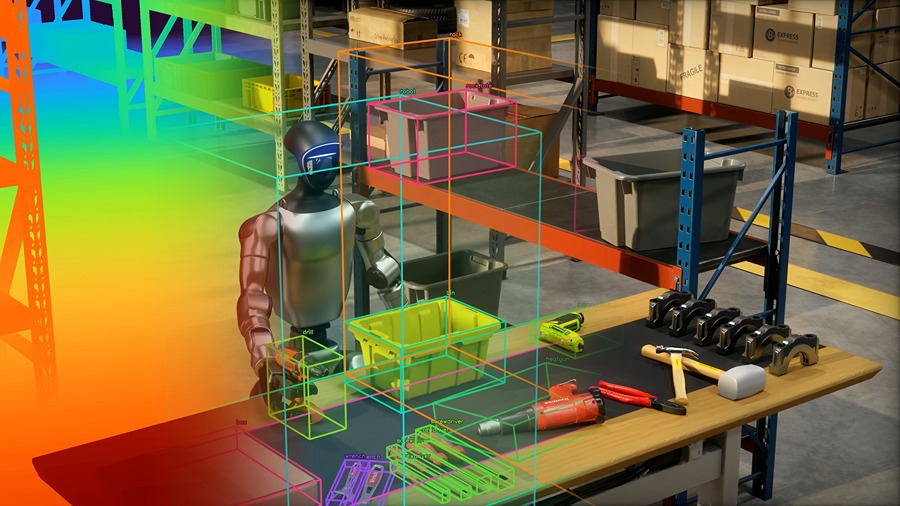
NVIDIA has added Omniverse libraries to its Agent Toolkit, giving AI agents the tools to bring physical AI capabilities into existing applications and prepare 3D content for simulation. The addition lets agents build workflows, inspect scenes, flag issues and prepare assets, helping developers move faster from raw 3D content to simulation-ready environments.
“The physical AI era will be built in simulation first,” said Jensen Huang, founder and CEO of NVIDIA. “NVIDIA Agent Toolkit with Omniverse libraries brings AI agents into the 3D tools developers already use, helping build the simulation-ready worlds where robots, factories and autonomous systems are trained and tested long before they reach the real world.”
The release includes three libraries:
- NVIDIA RTX sensor simulation: Ovrtx generates camera, lidar, radar and other sensor outputs from 3D scenes, letting developers and AI agents test how physical AI systems may perceive virtual environments.
- Physical behavior: Ovphysx applies GPU-accelerated physics, modeling properties such as collisions, mass, friction and motion, so teams can test how objects and systems interact in simulation.
- Simulation-ready 3D objects: CAD-to-SimReady skills convert CAD data into SimReady assets built on OpenUSD, giving 3D content the properties needed for physical AI simulation and virtual testing.
SideFX is using OpenUSD workflows along with the ovrtx and ovphysx libraries to test agent integration inside Houdini, its 3D content creation tool, allowing technical artists to generate content, run physics tests and prepare assets for simulation. PTC is also integrating the libraries into its workflows.
“Procedural 3D creation is essential to building the complex, controllable worlds needed for simulation, robotics and industrial AI,” said Kim Davidson, president and CEO of SideFX. “With NVIDIA Omniverse libraries and OpenUSD, SideFX is exploring how agent-ready tools can support Houdini workflows, helping technical artists review, test and prepare procedural content for simulation while staying in control of the creative process.”
Several startups, including participants in the NVIDIA Inception program, are building on the libraries as well. Palatial is using the CAD-to-SimReady skills to automate creation and validation of SimReady assets from CAD input. Lightwheel is using Omniverse Content Agents, powered by OpenUSD, within its SimReadyGen technology to generate physically accurate SimReady assets from text prompts. ForgeCAD and Moonlake AI are testing agent-driven workflows that use Omniverse capabilities to generate, augment and prepare 3D assets for simulation.
At SIGGRAPH, NVIDIA showed “SimReady” Blender, a workflow built with the Omniverse libraries and NVIDIA NemoClaw that adds RTX sensor simulation, physics and asset validation into Blender. The workflow is now available as an open blueprint on GitHub for integrating Omniverse libraries into Blender. NVIDIA said the workflows can run locally on RTX-powered systems, including NVIDIA RTX Spark, up to GB300-powered systems using NVIDIA DGX Station. RTX Spark systems are set for release this fall from ASUS, Dell Technologies, HP, Lenovo, Microsoft Surface and MSI, with Acer and GIGABYTE models to follow. DGX Station systems are available to order now from ASUS, Dell, GIGABYTE, HP, MSI, Supermicro and Exxact.
“Engineering teams are seeking more connected ways to design, collaborate and simulate throughout the development process,” said Neil Barua, president and CEO of PTC. “PTC’s work with NVIDIA supports that broader vision, while NVIDIA Omniverse libraries help enable simulation-ready workflows that bring validation and testing closer to where products are designed.”
Source: NVIDIA
About NVIDIA

NVIDIA, founded in 1993 and headquartered in Santa Clara, CA, designs and manufactures graphics processing units, systems on chips, networking hardware, and AI intelligence software such as CUDA. Its products serve industries including gaming, data centers, autonomous vehicles, professional visualization, robotics, health care, and energy. The company introduced the GPU in 1999 and later expanded into accelerated computing and AI infrastructure. In gaming, its GPUs support high-performance rendering, while in AI and high-performance computing, its systems provide the infrastructure for training and deploying large-scale models. NVIDIA also develops tools for robotics and autonomous driving.
