

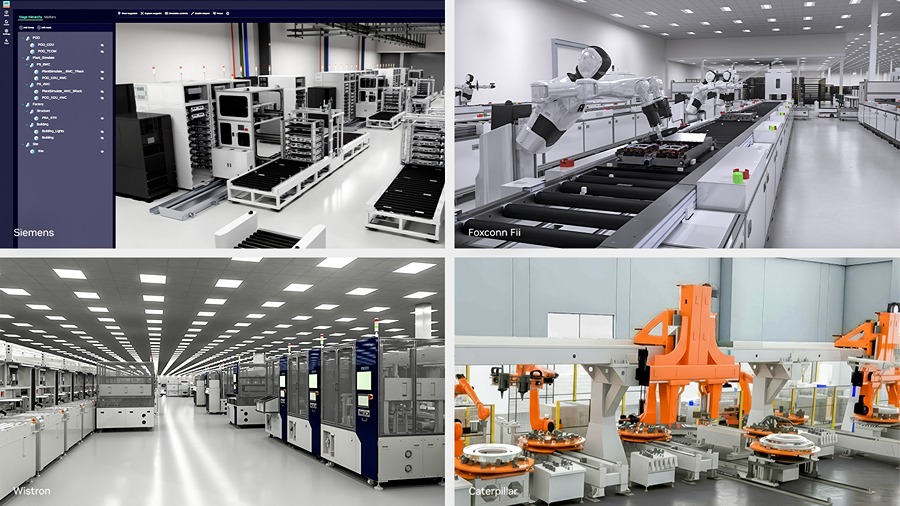
WASHINGTON, DC (GTC), Nov 3, 2025 – NVIDIA said manufacturers, software developers, and robotics companies are using NVIDIA Omniverse technologies to design and operate robotic factories. The tools help companies build and test robots in virtual environments before deployment. These systems are being developed to improve production efficiency and address labor shortages.
“AI is transforming the world’s factories into intelligent thinking machines – the engines of a new industrial revolution,” said Jensen Huang, founder and CEO of NVIDIA. “Together with American’s manufacturing leaders, we’re building physical AI, Omniverse digital twins and collaborative robots that will drive productivity, resilience and competitiveness across the U.S. industrial base.”
The Operating System for the Industrial AI Era
NVIDIA announced that it is expanding its “Mega” NVIDIA Omniverse Blueprint for simulating robot fleets to include technologies for designing and simulating factory digital twins.
Siemens has developed digital twin software that supports the Mega Omniverse Blueprint. In beta testing, the technology stack will be included in the Siemens Xcelerator platform. It is designed to help engineers create and manage digital twins of factories that combine 3D models with live operational data. The system enables simulation, optimization, and performance monitoring for factories, products, and data centers.
FANUC and Foxconn are among the first robot makers to use 3D, OpenUSD-based digital twins of their robots. The approach allows manufacturers to place equipment models into their digital twins.
America’s Leaders Build AI-Driven Factories to Accelerate Manufacturing
In 2025, companies announced $1.2 trillion in investments to expand U.S. production in electronics, pharmaceutical, and semiconductor manufacturers. Many firms are using software applications and Omniverse tools to build robotic factories. These systems apply physical AI and simulation to accelerate manufacturing.
Belden has implemented Accenture’s Physical AI Orchestrator, which combines NVIDIA Omniverse libraries, the NVIDIA Metropolis platform, and Accenture’s agentic AI. The system creates virtual safety fences for hazard detection and inspection in factories and warehouses.
Caterpillar is applying Omniverse to build digital twins of its factories and supply chains. The models support predictive maintenance and dynamic scheduling. The company also uses NVIDIA NIM microservices to automate workflows and forecast maintenance needs, along with NVIDIA cuOpt software to improve supply chain efficiency.
Lucid Motors is using Omniverse to develop digital twins of its factories for planning, optimization, and AI-based robotics training. Toyota is using idealworks’ iw.sim technology, which incorporates tools from the Mega Omniverse Blueprint, to build a digital twin of its Georgetown, KE plant and test automation scenarios.
TSMC is using NVIDIA Omniverse to support fab design and construction. It is also applying the NVIDIA Isaac platform to develop robots for its Phoenix, AZ facility.
Wistron is using NVIDIA AI and Omniverse tools to implement digital testing and validation processes for systems assembled at its Fort Worth, TX plant.
Leading Robot Developers Assemble America’s New Robotic Workforce
Robotics companies are using NVIDIA’s three-computer architecture to deploy fleets of robots that will play a critical role in bridging skills gaps, enhancing worker productivity and improving safety.
Figure and NVIDIA announced a collaboration to accelerate humanoid robotics. Using NVIDIA accelerated computing to build its Helix vision language action model and the Isaac platform for simulation and training, Figure is building a humanoid fleet capable from household chores to industrial support.
Agility Robotics’ humanoid, Digit, uses the NVIDIA Isaac Lab framework to refine whole-body control through millions of reinforcement learning scenarios, which accelerate enhancements to its skillsets such as step recovery from environmental disturbances, needed in manufacturing and logistics facilities. Digit is powered by the NVIDIA Jetson AGX Thor module, enabling navigation and decision-making.
Amazon Robotics is using Omniverse libraries and frameworks to develop manipulation systems and mobile robots that run on the NVIDIA Jetson platform. Simulation-based training was used to move the BlueJay robot, designed for picking, stowing, and consolidating tasks, from concept to production in about a year.
Skild AI is building a robotics foundation model that spans humanoid robots, using Isaac Lab for locomotion and manipulation tasks training and NVIDIA Cosmos foundation models for generating training datasets. FieldAI is training robot brains for monitoring and inspection in construction, and oil and gas environments, using Isaac Lab for learning and NVIDIA Isaac Sim for data generation and validation.
AI Infrastructure Accelerates Industrial Digitalization
NVIDIA provides edge solutions and works with cloud service providers to offer access to the AI and simulation infrastructure to accelerate manufacturing in America.
Google Cloud announced that its G4 instances powered by NVIDIA RTX 6000 Blackwell GPUs are available, while Microsoft will soon offer these GPUs in Azure and at the edge.
Source: NVIDIA
About NVIDIA

NVIDIA, founded in 1993 and headquartered in Santa Clara, CA, designs and manufactures graphics processing units, systems on chips, networking hardware, and AI intelligence software such as CUDA. Its products serve industries including gaming, data centers, autonomous vehicles, professional visualization, robotics, health care, and energy. The company introduced the GPU in 1999 and later expanded into accelerated computing and AI infrastructure. In gaming, its GPUs support high-performance rendering, while in AI and high-performance computing, its systems provide the infrastructure for training and deploying large-scale models. NVIDIA also develops tools for robotics and autonomous driving. For the fiscal quarter ending in July 2025, the company reported revenue of $46.7B and net income of $26.4B.
