

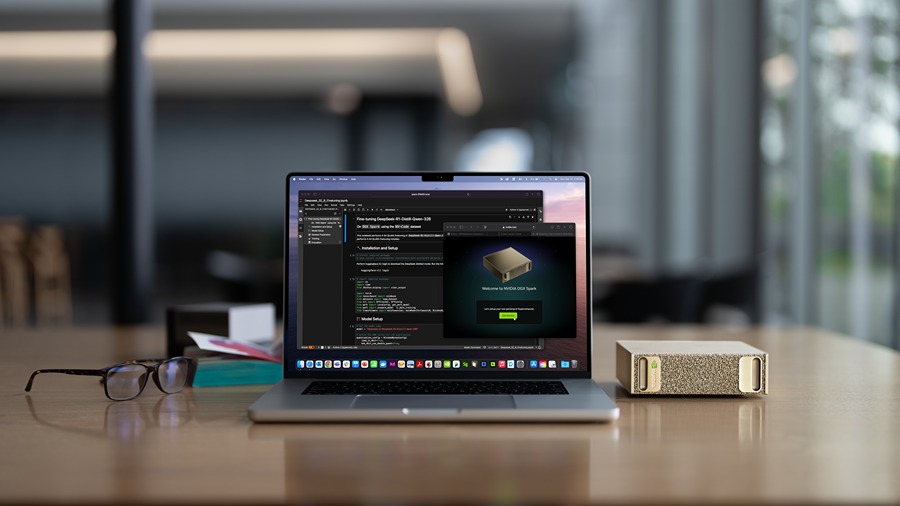
NVIDIA DGX Spark is an AI supercomputer designed for local development and testing. As AI models grow larger, developers face limits in memory and processing on PCs, and laptops, forcing them to rely on cloud or data center resources. The DGX Spark provides up to one petaflop of AI performance and 128 gigabytes of memory in a desktop form factor. It can run inference on models with as many as 200 billion parameters and fine-tune models with up to 70 billion parameters. Developers can also use DGX Spark to build AI agents and run software stacks locally.
“In 2016, we built DGX-1 to give AI researchers their own supercomputer. I hand-delivered the first system to Elon at a small startup called OpenAI – and from it came ChatGPT, kickstarting the AI revolution,” said Jensen Huang, founder and CEO of NVIDIA. “DGX-1 launched the era of AI supercomputers and unlocked the scaling laws that drive modern AI. With DGX Spark, we return to that mission – placing an AI computer in the hands of every developer to ignite the next wave of breakthroughs.”
DGX Spark combines the full NVIDIA AI platform – GPUs, CPUs, networking, CUDA libraries and AI software – into a system suitable for labs or offices. It is designed to accelerate development in agent-based and physical AI.
Each DGX Spark delivers up to 1 petaflop of AI performance, powered by an NVIDIA GB10 Grace Blackwell superchip. The system features NVIDIA ConnectX-7 200 Gb/s networking and NVLink-C2C technology, which offers 5x the bandwidth of fifth-generation PCIe with 128GB of CPU-GPU memory.
The DGX Spark comes with the NVIDIA AI software stack preinstalled. It provides access to NVIDIA’s AI ecosystem, including models, libraries and NIM microservices, for development and testing. Developers can use DGX Spark to customize Black Forest Labs’ FLUX.1 models for image generation, create vision search and summarization agents with the NVIDIA Cosmos Reason vision language model, or create chatbots using the Qwen3 model.
Huang hand-delivered one of the first units of DGX Spark to Elon Musk, chief engineer at SpaceX. The exchange recalls 2016, when Musk’s team received the first NVIDIA DGX-1 supercomputer.
Other recipients of DGX Spark, including Anaconda, Cadence, ComfyUI, Docker, Google, Hugging Face, JetBrains, LM Studio, Meta, Microsoft, Ollama and Roboflow, are testing their tools, software and models for DGX Spark.
“DGX Spark allows us to access peta-scale computing on our desktop,” said Kyunghyun Cho, professor of computer and data science at the NYU Global AI Frontier Lab. “This new way to conduct AI research and development enables us to rapidly prototype and experiment with advanced AI algorithms and models – even for privacy- and security-sensitive applications, such as healthcare.”
Click here to buy DGX Spark online. It is available since Oct 15, 2025.
Source: NVIDIA
About NVIDIA
NVIDIA, founded in 1993 and headquartered in Santa Clara, CA, designs and manufactures graphics processing units, systems on chips, networking hardware, and AI intelligence software such as CUDA. Its products serve industries including gaming, data centers, autonomous vehicles, professional visualization, robotics, health care, and energy. The company introduced the GPU in 1999 and later expanded into accelerated computing and AI infrastructure. In gaming, its GPUs support high-performance rendering, while in AI and high-performance computing, its systems provide the infrastructure for training and deploying large-scale models. NVIDIA also develops tools for robotics and autonomous driving. For the fiscal quarter ending in July 2025, the company reported revenue of $46.7B and net income of $26.4B.
