

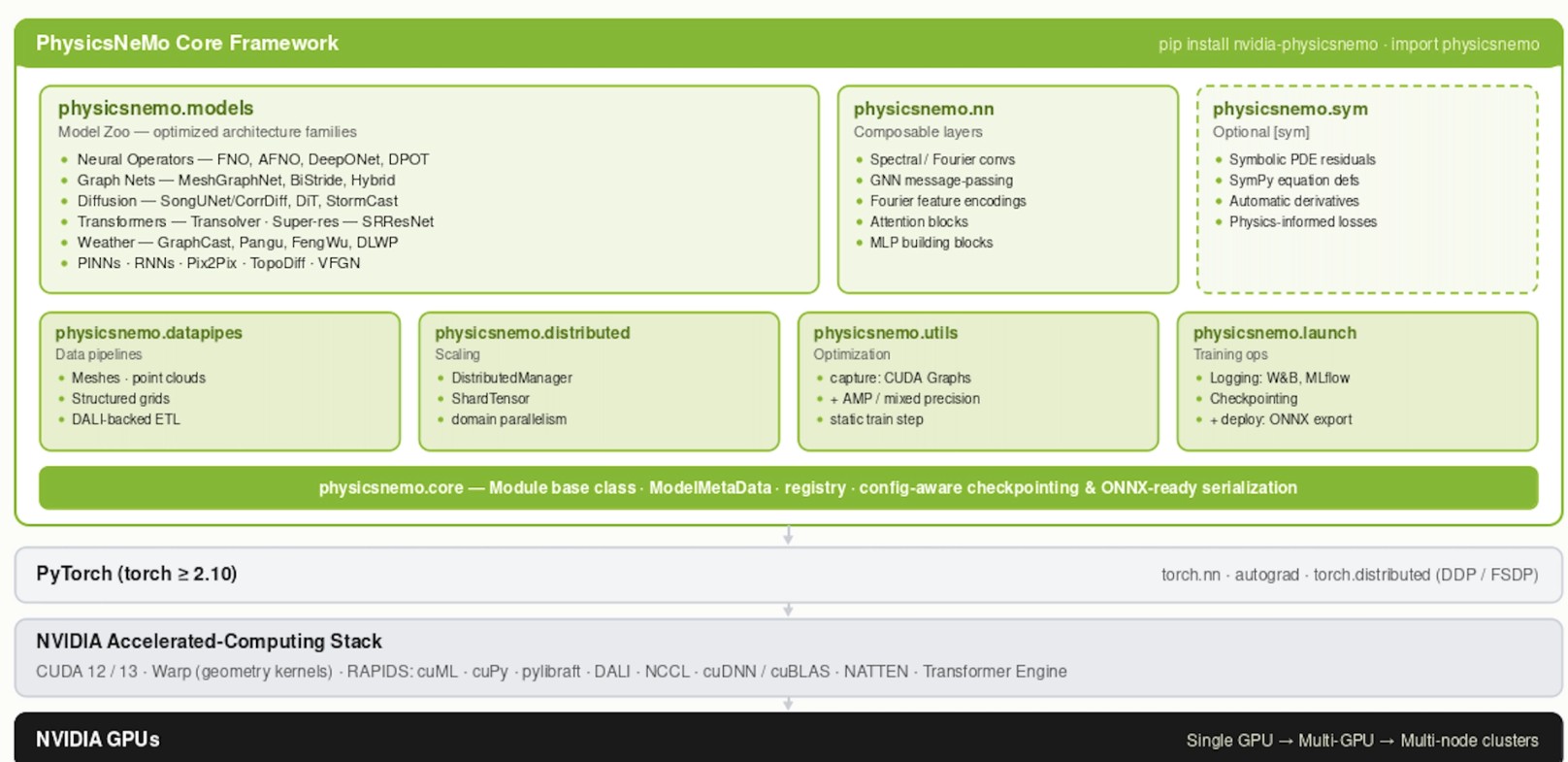
Luminary is building large physics models on Nvidia PhysicsNeMo, an open-source, PyTorch-based framework designed to train and deploy AI models for engineering simulation. PhysicsNeMo provides infrastructure that helps developers work with complex scientific data, scale training across GPUs, and incorporate physical principles into machine learning models.
Physics AI models learn from simulation or observational data to approximate computationally demanding numerical simulations, including computational fluid dynamics, finite element analysis, electromagnetics, and structural analysis. Luminary cites its work with Northrop Grumman Space Systems as an example. A large physics model trained using the PhysicsNeMo DoMINO architecture predicted spacecraft nozzle performance in 2–5 seconds, compared with CFD simulations requiring up to 12 hours.
PhysicsNeMo includes data pipelines tailored to engineering datasets, distributed training capabilities, physics-informed tools, and model architectures. Its model zoo includes neural operators, graph networks, diffusion models, transformers, and physics-informed neural networks. Luminary highlights DoMINO and Transolver as particularly important for engineering-scale CFD because they can handle complex geometries and predict flow fields much faster than conventional simulations.
A major challenge is preparing simulation data for AI training. Engineering datasets may contain meshes, pressure and velocity fields, operating parameters, and metadata spread across several file formats. PhysicsNeMo’s CAEDataset helps organize, normalize, sample, cache, and distribute this information for training.
Luminary also uses PhysicsNeMo’s domain-parallel capabilities when individual CFD samples are too large for a single GPU. ShardTensor distributes large physical domains across multiple GPUs, while DistributedManager simplifies multi-GPU and multi-node training.
Luminary argues that this reusable foundation allows developers to concentrate on model architecture and accuracy rather than repeatedly building training infrastructure. The company uses PhysicsNeMo to support models such as Luminary-SMART while adding validation, uncertainty quantification, data infrastructure, and enterprise deployment capabilities for engineering teams.
