


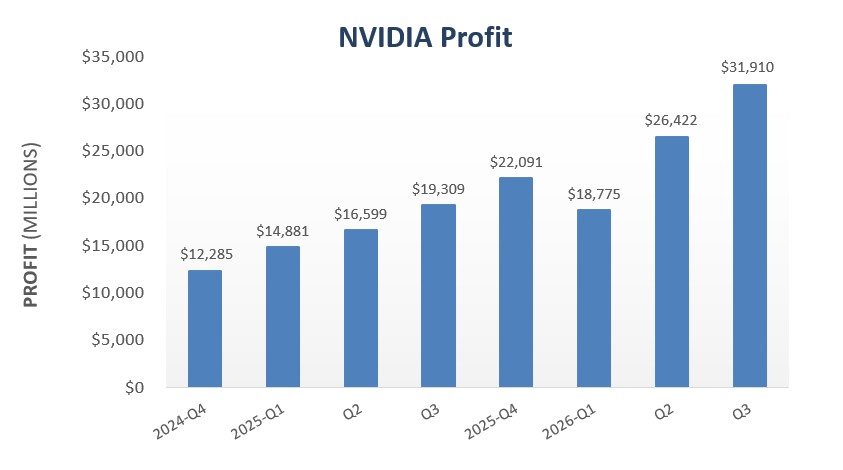
NVIDIA has announced its Q3 FY26 results, reporting $57B in revenue – a 22% increase from $46.7B in Q2 FY26 – with a profit of $31.9B.
Third Quarter Financial Highlights
- Data center revenue reached $51.2B, up 25% from the previous quarter and up 66% year-over-year.
- Professional Visualization (ProViz) reached $760M, up 26% from the previous quarter and up 56% from a year ago.
- Automotive and robotics reached $592 million, up 1% from the previous quarter and up 32% from a year ago.
- Gaming revenue reached $4.3 billion, up 30% year-over-year.
- Announced an agreement to deploy at least 10 gigawatts of NVIDIA systems with OpenAI.
- Highlighted first NVIDIA Blackwell wafer produced on U.S. soil at TSMC’s Arizona facility.

“Blackwell sales are off the charts, and cloud GPUs are sold out,” said Jensen Huang, founder and CEO of NVIDIA. “Compute demand keeps accelerating and compounding across training and inference – each growing exponentially. We’ve entered the virtuous cycle of AI. The AI ecosystem is scaling fast – with more new foundation model makers, more AI startups, across more industries, and in more countries. AI is going everywhere, doing everything, all at once.”
A detailed chart outlining the financial results is available here, providing a comprehensive breakdown of key metrics and performance indicators for better insight into the company’s financial standing.
Source: NVIDIA
About NVIDIA

NVIDIA, founded in 1993 and headquartered in Santa Clara, CA, designs and manufactures graphics processing units, systems on chips, networking hardware, and AI intelligence software such as CUDA. Its products serve industries including gaming, data centers, autonomous vehicles, professional visualization, robotics, health care, and energy. The company introduced the GPU in 1999 and later expanded into accelerated computing and AI infrastructure. In gaming, its GPUs support high-performance rendering, while in AI and high-performance computing, its systems provide the infrastructure for training and deploying large-scale models. NVIDIA also develops tools for robotics and autonomous driving.
