

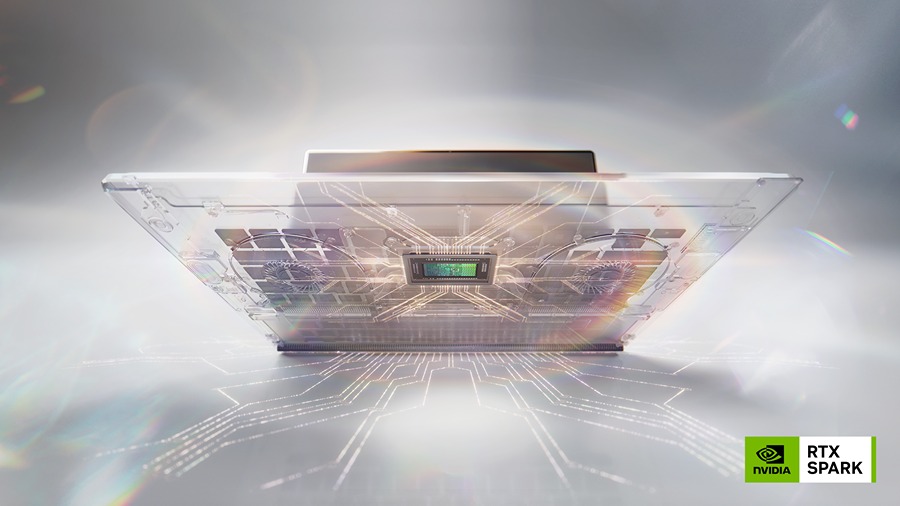
TAIPEI, Taiwan (NVIDIA GTC), June 5, 2026 – NVIDIA introduced RTX Spark, a Windows PC superchip built to run personal AI agents on laptops and desktops. The chip combines Blackwell RTX graphics, a 20-core Grace CPU, up to 1 petaflop of AI compute and 128GB of memory as NVIDIA and Microsoft work on secure on-device agent experiences for Windows.
RTX Spark targets AI workloads, content creation and gaming on slim Windows laptops and desktop PCs. NVIDIA said the chip is designed for systems with all-day battery life and high energy efficiency.
“The PC is being reinvented,” said Jensen Huang, founder and CEO of NVIDIA. “For forty years, you launched apps. Click. Type. With RTX Spark and Microsoft Windows, you ask – and the PC does the work. RTX Spark brings everything NVIDIA has built – CUDA, RTX, our AI platform – into a single superchip. Local agents. Frontier models. Creative workflows. RTX games. All on a laptop. This is the new PC. The personal AI computer.”
The RTX Spark superchip brings together NVIDIA CUDA, RTX, DLSS, FP4, TensorRT, OptiX, Reflex and G-SYNC technologies. These components support AI processing, rendering, graphics acceleration, model execution and gaming workloads.
The hardware includes an NVIDIA Blackwell RTX GPU with 6,144 CUDA cores. It also uses fifth-generation Tensor Cores with FP4 precision for AI computation.
The GPU connects to a high-performance, 20-core NVIDIA Grace CPU through NVIDIA NVLink-C2C. MediaTek collaborated with NVIDIA on the custom CPU design, contributing to power efficiency, performance and connectivity.
Purpose-Built for Personal Agents
NVIDIA positioned RTX Spark around the use of AI agents on local devices. The company cited open-source projects such as OpenClaw and Hermes Agent, which have gained activity on developer networks including GitHub and OpenRouter.
Adoption has been limited by security and privacy challenges on users’ primary PCs. NVIDIA and Microsoft are working on a Windows software environment that runs on-device agents under user control.
The collaboration uses new Windows security primitives and the NVIDIA OpenShell runtime. The Windows components provide identity, containment, policy and end-to-end security functions for native agent execution.
NVIDIA OpenShell adds policy controls for agent behavior and routes queries to local models based on user privacy settings. It can also disguise personal information in queries sent to cloud models.
Hermes Agent and OpenClaw are adopting the security and privacy layer in new Windows apps. These apps are designed to execute tasks in Windows applications, process cross-app workflows, generate images and video, code plug-ins and apps, and search local files semantically. NVIDIA and Microsoft plan to extend the work to RTX Spark-powered Windows agent experiences accessible from the Windows taskbar user interface.
“We are strong supporters of deploying agents like OpenClaw securely into the Windows ecosystem,” said Vincent Koc, chief architect at the OpenClaw Foundation. “Running solutions like OpenShell and the Microsoft security primitives on RTX Spark will enable users to leverage a fully integrated stack for private, personal agents running on device.”
“At Nous, we expect tasks to increasingly run on device as personal agents like our Hermes Agent become more capable and ubiquitous,” said Dillon Rolnick, CEO of Nous Research. “RTX Spark and NVIDIA OpenShell give Hermes users a powerful and secure environment for agents to run and work alongside you. You realize you’re buying a full-fledged assistant, not a typical laptop.”
“Our goal is to deliver unmetered intelligence to every home and every desk with Windows,” said Satya Nadella, chairman and CEO of Microsoft. “RTX Spark marks a real breakthrough towards that vision.”
Full-Stack RTX Creating and Gaming
NVIDIA detailed RTX Spark’s AI and graphics workload range for Windows PCs. The superchip targets local model execution, 3D rendering, high-resolution video editing and RTX gaming on laptops and desktops. It supports 120-billion-parameter LLMs with a 1 million-token context, 90GB 3D scenes, 12K 4:2:2 video workflows and 1440p gaming above 100 frames per second.
RTX Spark brings NVIDIA CUDA, RTX, DLSS, FP4, TensorRT, OptiX, Reflex and G-SYNC technologies to Windows systems for creators, AI developers and gamers. These components support AI processing, graphics rendering, model execution, frame generation and low-latency gaming workloads.
RTX Spark renders 90GB 3D scenes using OptiX and DLSS, and edits 12K 4:2:2 video through the NVIDIA Blackwell decoder. For gaming, it runs AAA titles at 1440p resolution and more than 100 frames per second with ray tracing, DLSS and Reflex.
RTX Spark will also support new RTX capabilities, including DLSS 4.5 Ray Reconstruction. The feature uses a second-generation transformer model and is scheduled for Blender 5.3 and dozens of games.
Delivering Powerful Creative Experiences
NVIDIA is also bringing RTX Video with 4x Frame Generation to ComfyUI. RTX technologies are used in more than 1,000 games and applications.
“The best creative work in the world happens in Adobe tools from Adobe Firefly to Photoshop and Premiere, and the expansion of our partnership with NVIDIA and Microsoft will make those experiences faster and more powerful than ever,” said Shantanu Narayen, chair and CEO of Adobe. “Together, we are building AI-native creative experiences for RTX Spark that deliver the performance, intelligence and responsiveness people need to create at the pace of their ambition.”
More than 100 Windows software providers and game developers are supporting RTX Spark. The group includes Adobe, Blackmagic Design, Blender, CapCut, ComfyUI, OTOY, KRAFTON, NetEase, Remedy Entertainment, Riot Games and Xbox.
NVIDIA is working with Adobe to adapt Adobe Premiere and Photoshop for RTX Spark. The work covers Firefly-powered Generative Fill in Photoshop and Generative Extend in Premiere, with NVIDIA citing up to 2x faster AI, editing, coloring and effects processing across creative workflows.
Adobe Premiere will include a new video pipeline that uses RTX Spark’s unified memory, Blackwell GPU and TensorRT software. The pipeline supports real-time editing and color correction, GPU-accelerated AI processing and more efficient rendering of complex timelines.
Adobe Substance 3D Painter and Stager will run on RTX Spark for 3D texturing and scene creation. Adobe’s next-generation Photoshop engine will also use GPU-accelerated compositing, live filters, high dynamic range imaging and natural brushing with TensorRT.
Premium Designs in All Sizes
Adobe plans to extend Premiere and Photoshop to work with Windows agents for creation, editing and design tasks. Updates to Premiere, Photoshop and Substance are expected to start rolling out alongside RTX Spark availability.
RTX Spark laptops are designed to be 14 mm and 3 pounds. They will be available in 14- to 16-inch sizes, with aluminum chassis, tandem OLED displays and NVIDIA G-SYNC technology.
Small RTX Spark desktops are built for agents, creative workloads, gaming and everyday productivity. NVIDIA and Microsoft are also extending Windows agent work to DGX Station for Windows, bringing Blackwell-based agent computing to deskside systems for enterprise developers.
Availability
RTX Spark laptops and compact desktops are expected this fall from ASUS, Dell, HP, Lenovo, Microsoft Surface and MSI, with Acer and GIGABYTE models to follow.
Source: NVIDIA
About NVIDIA

NVIDIA, founded in 1993 and headquartered in Santa Clara, CA, designs and manufactures graphics processing units, systems on chips, networking hardware, and AI intelligence software such as CUDA. Its products serve industries including gaming, data centers, autonomous vehicles, professional visualization, robotics, health care, and energy. The company introduced the GPU in 1999 and later expanded into accelerated computing and AI infrastructure. In gaming, its GPUs support high-performance rendering, while in AI and high-performance computing, its systems provide the infrastructure for training and deploying large-scale models. NVIDIA also develops tools for robotics and autonomous driving.
About Microsoft

Microsoft is a global technology company founded in 1975 and headquartered in Redmond, WA. The company develops software, hardware, cloud services, and digital platforms for business and consumer users. Its products include the Windows OS, Microsoft 365 productivity applications, Xbox gaming consoles, and Surface devices. Microsoft also operates online services such as Azure cloud computing, Bing search, LinkedIn, and the Microsoft Store. The company provides enterprise software, business applications, development tools, and security services for industries including finance, healthcare, retail, manufacturing, and government. Microsoft serves individual consumers, businesses, and public sector organizations through direct sales, partners, and cloud-based delivery models. It supports developers with platforms such as Visual Studio and related tools. Microsoft operates in approx. 200 countries. The company employs about 228,000 people worldwide.
