

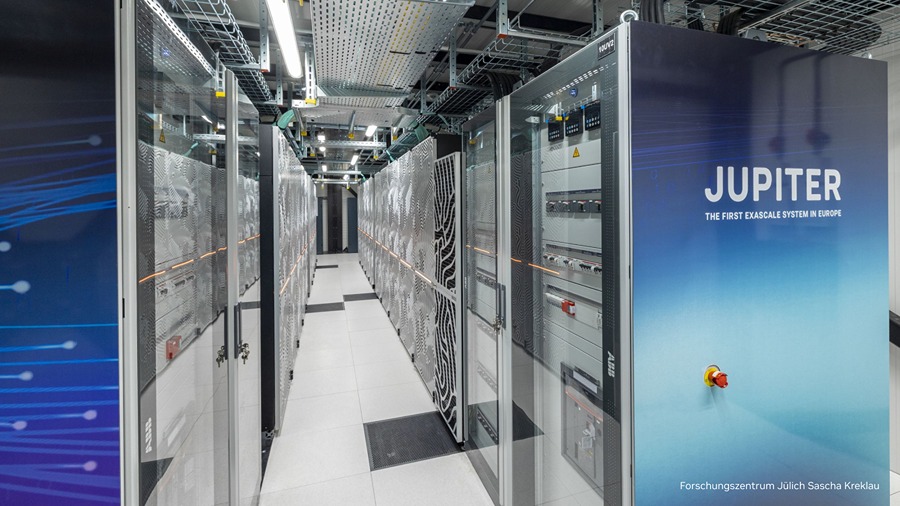
NVIDIA has run a 104-qubit simulation on the JUPITER supercomputer to test magic-state cultivation, a method for producing quantum states used in fault-tolerant computing. According to NVIDIA, the approach requires 90% fewer qubits than previous methods.
The simulation modeled hardware noise to evaluate how errors affect the process. It used 8,192 GPUs on JUPITER’s NVIDIA GH200 superchip-based system at the Jülich Supercomputing Centre.
“Useful quantum computing will require fantastically complex, fault-tolerant systems – and understanding how they behave at scale is essential to building them,” said Jensen Huang, founder and CEO of NVIDIA. “Our results from Jülich show how quantum processors and GPU supercomputers can work together to tackle research that would otherwise be out of reach – accelerating the discovery of transformative quantum applications.”
“Europe’s investment in JUPITER gives researchers the ability to investigate questions that were previously beyond reach,” said Kristel Michielsen, director of the Jülich Supercomputing Centre at the Forschungszentrum Jülich facility. “Working with NVIDIA, we’re bringing that capability to quantum computing – helping scientists make better-informed decisions about the designs most likely to deliver useful applications.”
Testing Quantum Computation Under Noise
Fault-tolerant quantum computing addresses errors caused by noise during quantum operations. In the approach studied, computation consumes specially prepared quantum states called magic states.
NVIDIA reports that its researchers validated the magic-state cultivation approach under realistic noise. Earlier research at Jülich simulated 50 qubits under noiseless conditions. The new work examines the effects of hardware noise and supports evaluation of designs before quantum hardware is built.
Scaling from Development Systems to JUPITER
The memory required for quantum simulations can grow exponentially with the number of qubits, limiting the scale conventional computing systems can handle.
An NVIDIA GB200 NVL72 system at the NVIDIA Accelerated Quantum Research Center (NAQVC) served as the project’s development platform. Researchers scaled tests from four GPUs to hundreds before moving to JUPITER.
At the research center, the team developed and tested simulation methods, compared results with JUPITER and examined how accuracy changed with additional computing resources. NVIDIA reports that the work helped reduce a weeks-long simulation effort to days while preparing the team to use JUPITER’s computing capacity.
The simulations used NVIDIA cuQuantum software and the NVIDIA CUDA-Q platform’s layer for expressing the magic-state circuit.
About NVIDIA

NVIDIA, founded in 1993 and headquartered in Santa Clara, CA, designs and manufactures graphics processing units, systems on chips, networking hardware, and AI intelligence software such as CUDA. Its products serve industries including gaming, data centers, autonomous vehicles, professional visualization, robotics, health care, and energy. The company introduced the GPU in 1999 and later expanded into accelerated computing and AI infrastructure. In gaming, its GPUs support high-performance rendering, while in AI and high-performance computing, its systems provide the infrastructure for training and deploying large-scale models. NVIDIA also develops tools for robotics and autonomous driving.
