

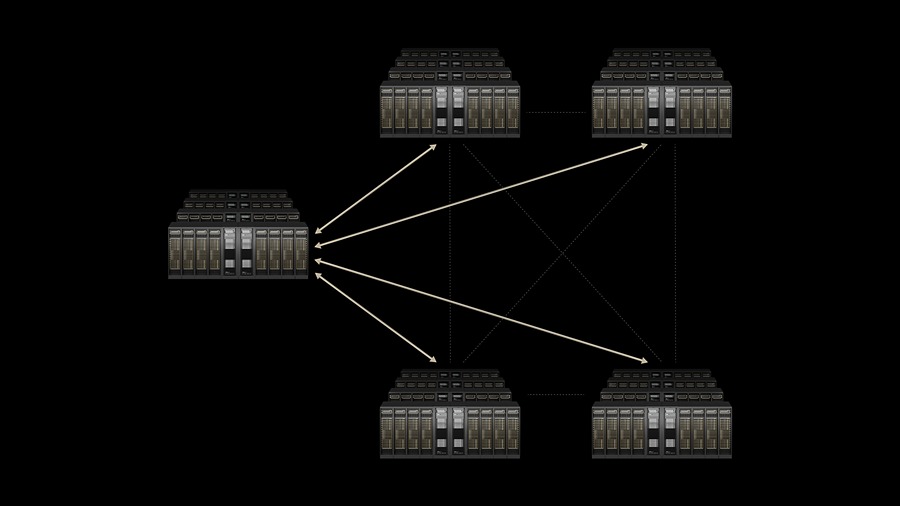
NVIDIA introduced Spectrum-XGS Ethernet, a technology meant to link multiple data centers, so they operate as a single, large-scale AI system. The move targets a practical constraint: many facilities are hitting power and space limits as AI workloads grow.
Scaling requires networking across sites, not just within one building. Traditional, off-the-shelf Ethernet can struggle at that scale because of higher latency, jitter and inconsistent throughput. Spectrum-XGS aims to address those issues so operators can extend AI clusters across campuses with predictable performance.
Spectrum-XGS Ethernet is an addition to the NVIDIA Spectrum-X ethernet platform that removes these boundaries by introducing scale-across infrastructure. NVIDIA positions Spectrum-XGS Ethernet as a third approach to AI infrastructure, alongside scale-up and scale-out. The goal is to extend Spectrum-X performance across links that connect multiple, distributed data centers. In practice, this lets operators combine sites into unified AI factories capable of training and serving large models. For U.S. cloud providers and enterprises, the model targets predictable, low-latency networking across campuses rather than relying solely on bigger servers or larger single-site clusters.
“The AI industrial revolution is here, and giant-scale AI factories are the essential infrastructure,” said Jensen Huang, founder and CEO of NVIDIA. “With NVIDIA Spectrum-XGS Ethernet, we add scale-across to scale-up and scale-out capabilities to link data centers across cities, nations and continents into vast, giga-scale AI super-factories.”
Spectrum-XGS ethernet is integrated into the Spectrum-X platform, featuring algorithms that dynamically adapt the network to the distance between data center facilities.
With auto-adjusted distance congestion control, precision latency management and end-to-end telemetry, Spectrum-XGS Ethernet nearly doubles the performance of the NVIDIA Collective Communications Library, accelerating multi-GPU and multi-node communication to deliver expected performance across AI clusters. As a result, multiple data centers can operate as a single AI super-factory, optimized for long-distance connectivity.
CoreWeave will be among the first to connect its data centers with Spectrum-XGS Ethernet. “CoreWeave’s mission is to deliver the most powerful AI infrastructure to innovators everywhere,” said Peter Salanki, cofounder and chief technology officer of CoreWeave. “With NVIDIA Spectrum-XGS, we can connect our data centers into a single, unified supercomputer, giving our customers access to giga-scale AI that will accelerate breakthroughs across every industry.”
Spectrum-X Ethernet targets higher bandwidth density than standard Ethernet in AI clusters, including the world’s largest AI supercomputer. The platform pairs NVIDIA Spectrum-X switches with NVIDIA ConnectX-8 SuperNICs to reduce latency and stabilize throughput. It is aimed at U.S. enterprises and cloud providers that need consistent network performance for training and inference at scale.
The announcement follows innovation announcements from NVIDIA, including NVIDIA Spectrum-X and NVIDIA Quantum-X silicon photonics networking switches, which enable AI factories to connect millions of GPUs across sites while reducing energy consumption and operational costs.
Availability
NVIDIA Spectrum-XGS Ethernet is available as part of the NVIDIA Spectrum-X Ethernet platform.
To know about Spectrum-XGS Ethernet, click here.
Source: NVIDIA
About NVIDIA

NVIDIA Corporation, based in Santa Clara, CA, is a U.S. technology company specializing in the design and production of graphics processing units (GPUs). It’s hardware and software solutions support a range of applications and simulation. Operating for over 30 years, NVIDIA has seen strong financial growth, reporting $39.3 billion in revenue and $22.1 billion in net income for the fiscal quarter ending January 2025. Its headquarters are designed to promote a flat organizational structure that encourages open communication and collaboration between leadership and staff across industries. In gaming, its GPUs power high-performance visual rendering. In artificial intelligence and high-performance computing, NVIDIA provides the infrastructure needed for training and deploying large-scale models. The company also contributes to the automotive sector with systems for autonomous driving and supports robotics with tools for AI-based perception.
