

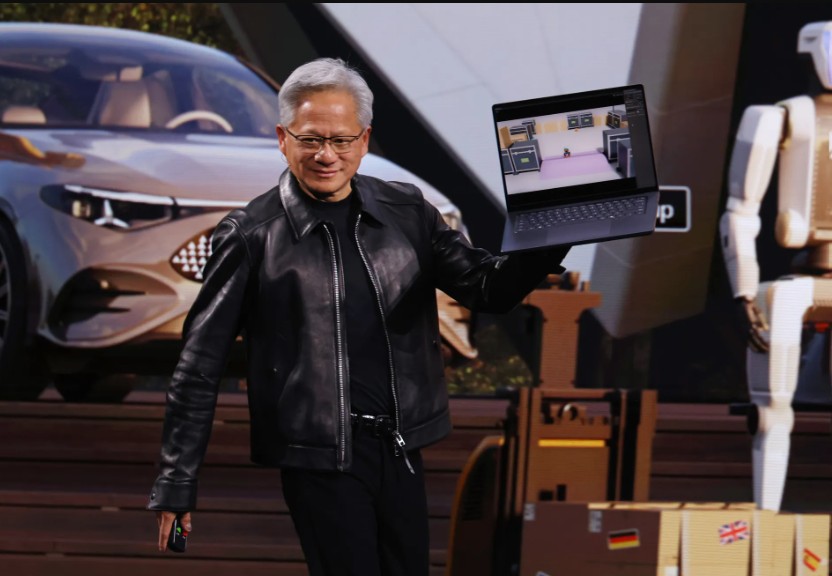
At Nvidia’s GTC conference in Berlin, CEO Jensen Huang outlined a vision for Europe built around modular data centers, AI agents, autonomous systems, and humanoid robots. His message was that Europe should become a producer of AI rather than simply consume technologies developed elsewhere, tells Wired.com (full article available to subscribers).
Central to that strategy is Nvidia’s DSX Pod, a modular AI factory designed to accelerate data center deployment. The system arrives largely assembled in a container and incorporates Nvidia’s Vera Rubin computing racks. According to Huang, a DSX Pod can become operational in 14 days, compared with the months or years conventional data center projects can require. Faster installation could be particularly valuable in Europe, where infrastructure development frequently faces lengthy approval and construction processes.
Huang argued that reducing deployment time also prevents expensive computing equipment from sitting idle while supporting infrastructure is completed. The concept reflects Nvidia’s broader push to treat AI infrastructure as a standardized, deployable system rather than a collection of individually integrated components.
Physical AI was another major theme. Huang described humanoid robotics as a potential major industry for Europe, pointing to the region’s manufacturing expertise. Nvidia announced a full-stack robotics platform intended to standardize robot configurations, along with Agile One, a preconfigured reference robot expected in the first quarter of 2027.
Nvidia is also extending physical AI into transportation and telecommunications. Huang highlighted partnerships with Volkswagen and Mercedes-Benz on autonomous vehicles and noted that telecom operators are adding Nvidia GPUs to cellular infrastructure.
AI agents add another layer to Nvidia’s infrastructure argument. As agents reason, iterate, and use software tools, they consume more tokens and computing resources. Huang expects companies to combine closed and customizable open models, often using proprietary organizational data. Together, these trends reinforce Nvidia’s case that Europe’s AI ambitions will depend as much on rapidly deployable computing infrastructure as on the models running on it.
