

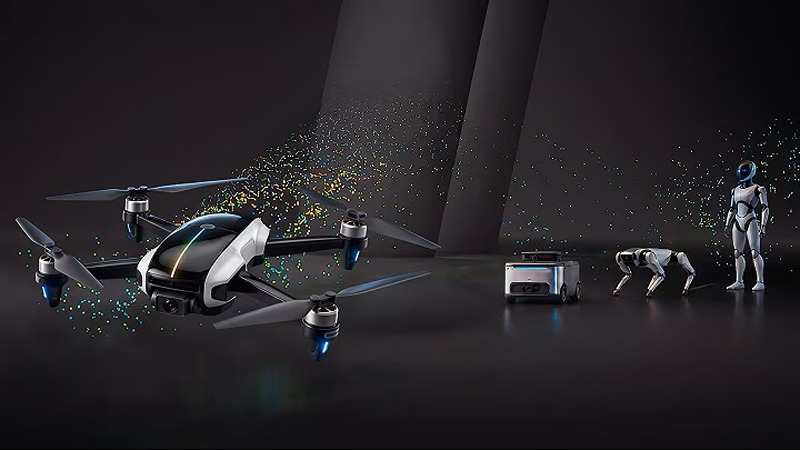
EINDHOVEN, Netherlands, Nov 20, 2026 – NXP Semiconductors has introduced a robotics development platform built on its Neural Axis Architecture, combining sensing, control, AI processing and communications within a distributed hardware and software framework. The platform includes a software development kit (SDK) and reference designs, supporting drone development.
The platform combines NXP’s hardware technologies with pre-integrated software components. According to NXP, the software and validated subsystem interoperability can reduce the time required for the development process to days or weeks.
Developers can begin with a motor control subsystem tested and validated with the SDK, then use the same development environment to add AI-based perception, flight control and navigation. The platform is designed to support development from individual robotic functions to complete physical AI systems.
Jerome Legros, vice president and general manager, Robotics, NXP Semiconductors said: “As autonomous robots increasingly move beyond controlled environments and into the spaces where people live and work, trust becomes a prerequisite for adoption. To deliver that trust, developers need a foundation designed with security, functional safety, real-time control and full lifecycle reliability in mind. NXP’s unified robotics platform brings together these non-negotiable capabilities in a scalable architecture that helps developers build the next generation of trusted physical AI systems.”
The platform’s modular SDK provides drivers, middleware integration, reference applications, configuration tools and reusable software components. It supports robotics frameworks and integrates with open-source technologies, including PX4, Zephyr and ROS 2.
James McClearen, CTO, blueflite, added: “For drone developers, speed is critical. Markets evolve quickly, customer requirements change rapidly and new autonomous capabilities are constantly emerging. NXP’s unified robotics platform is a ready-to-build foundation that shortens development cycles, allowing us to evaluate new ideas, prototype faster and bring innovative solutions to market more efficiently.”
Srdjan Kovačević, CEO & co-founder, Orqa commented: “In high-performance robotics, particularly drone systems, processing power alone isn’t enough. You need efficient communication between computing elements, predictable behavior and extremely low latency. Working closely with NXP helps us address these challenges at an architectural level, giving us a stronger foundation for the next generation of robotic systems. This matters even more when the real-world demands on advanced unmanned systems are more challenging than ever before.”
Drone Reference Designs and Hardware
The first reference designs address below functions involved in drone development:
- Autonomous computing and flight control: The NavQ95 platform, based on NXP’s i.MX 95 applications processor.
- Flight management: The Tropic VMU/FMU, based on the i.MX RT1064 crossover microcontroller (MCU).
- Intelligent sensor networking: The 100Base-T1 Sensor Node, based on the MCX N947 MCU.
- Motor control: An AM32-compliant electronic speed controller, based on the MCX A13 MCU.
Each reference design includes the safety and security capabilities of its primary processor, which can be activated independently of robotics-specific functionality. The reference designs and supporting SDK allow developers to establish initial drone functionality within 30 minutes.
Availability and Planned Expansion
NXP’s robotics platform is available now, including the drone reference designs and supporting SDK.
Although the initial reference designs focus on drones, NXP plans to extend the platform to autonomous systems requiring perception, navigation, motor control, connectivity and safe operation. Future reference designs will address service robots, autonomous mobile robots (AMRs) and other autonomous systems. Additional development support for these systems is expected in the second half of 2027.
Source: NXP Semiconductors
About NXP Semiconductors

NXP Semiconductors, established in 2006 as a spin-off from Philips, is headquartered in Eindhoven, Netherlands. The company specializes in high-performance mixed-signal and standard product solutions, including microcontrollers, application processors, communication processors, connectivity chipsets, analog and interface devices, RF power amplifiers, security controllers, and sensors. The products serve various industries such as automotive, industrial, Internet of Things (IoT), mobile, and communication infrastructure. With a global presence in over 30 countries, the company employs around 34,000 individuals. NXP is recognized for its innovations in near-field communication (NFC) technology and its significant contributions to automotive electronics, including microcontrollers and analog chips used in vehicle systems.
