

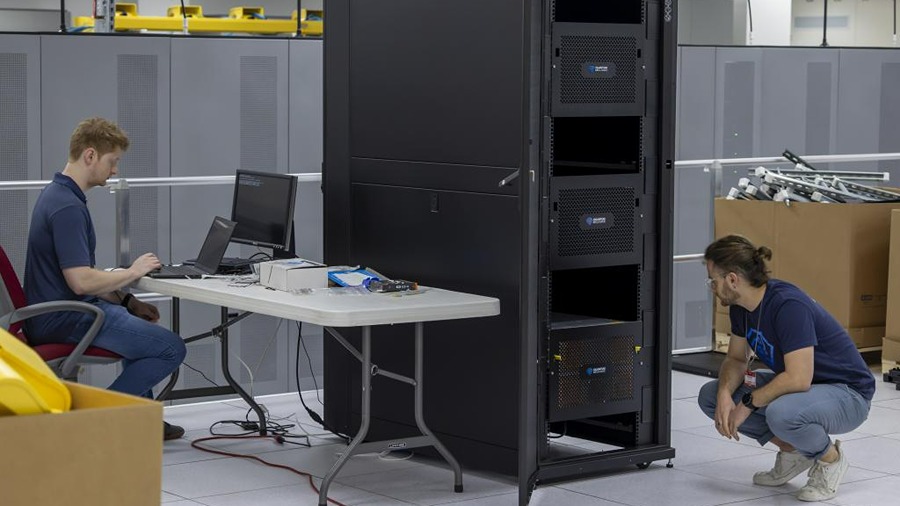
OAK RIDGE, TN, Sep 3, 2025 – Oak Ridge National Laboratory and Quantum Brilliance have installed a quantum computer system at the Oak Ridge Leadership Computing Facility (OLCF). The project will test how quantum and high-performance computing can work together at ORNL to accelerate scientific research and real-world applications.
“By hosting a Quantum Brilliance system on site, we’ll be maturing the real mechanics of hybrid computing – co‑scheduling, end‑to‑end performance tuning, data and workflow orchestration, workforce development and more – so we can eventually move HPC-quantum integration from a conceptual pilot to a fully embedded capability within leadership computing,” said OLCF program director Ashley Barker of ORNL. “Leveraging the potential power of quantum computing in a hybrid ecosystem is important to the nation and aligns with ORNL’s mission of boosting innovation, energy, competitiveness and national security.”
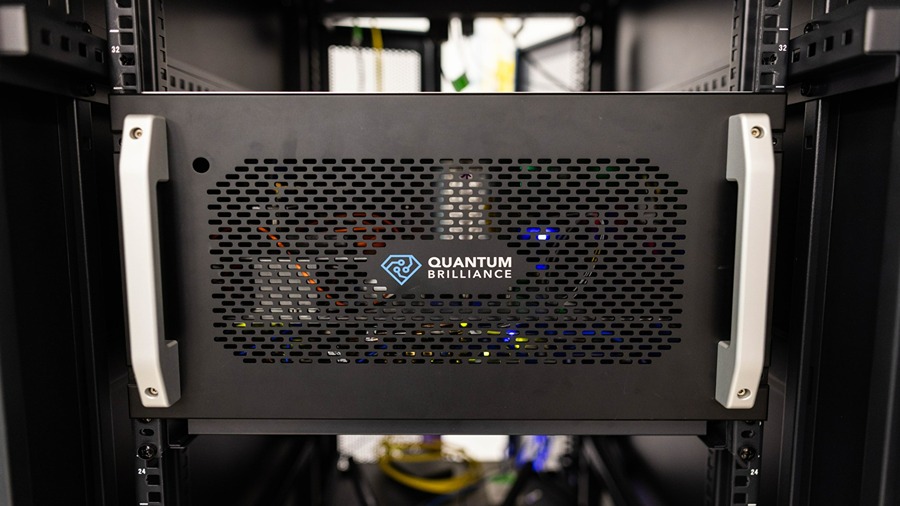
ORNL has installed a Quantum Brilliance system at the Oak Ridge Leadership Computing Facility (OLCF) to test hybrid quantum–high-performance computing workflows. A three-QPU, six-qubit cluster will probe scheduling, performance tuning, and workflow orchestration for scientific workloads. Last year, the OLCF published a paper in Future Generation Computer Systems proposing a framework to integrate quantum and classical computing. It focuses on hybrid execution: scheduling across heterogeneous hardware, coordinating workflows, and minimizing data movement to make near-term quantum devices usable within existing systems.
“This hybrid system provides ORNL researchers with a new platform to explore advanced computing methods, including parallelized quantum algorithms, that support tight integration with HPC systems. Our research into quantum-HPC integration is a fundamental part of the lab strategy to realize the next-generation of leadership-class computing systems,” said Travis Humble, director of the DOE’s Quantum Science Center, also located at ORNL.
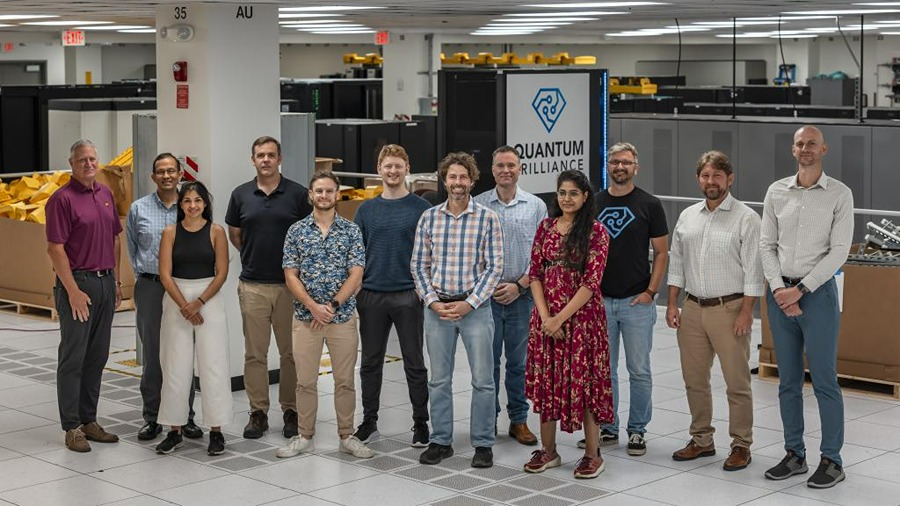
“Our collaboration with ORNL marks a significant milestone for Quantum Brilliance and the future of quantum computing and is the result of years of close collaboration with Travis Humble and the incredible team at ORNL. Together, we are working towards the vision of integrating our GPU-sized diamond quantum systems with ORNL’s world-class HPC infrastructure,” said Quantum Brilliance CEO Mark Luo.
“This effort demonstrates what is possible and paves the way for large-scale deployments globally, with hundreds of thousands, potentially millions, of systems. This is about so much more than just hardware – it is about building a future where quantum and classical systems collaborate on an unprecedented scale,” he added.
The OLCF installed a quantum cluster in its Advanced Computing Ecosystem testbed, a data center sandbox for experimenting new technologies. The setup includes three quantum development kits (QDKs). Each kit contains a parallelized quantum processing unit (QPU), for a total of three QPUs and six qubits. Current quantum computer systems have high error rates and require large cryogenic gear to keep qubits coherent. Quantum Brilliance’s diamond-based QPUs run at room temperature and fit into a small package, which makes them easier to host alongside standard data center equipment.
“Most qubit technologies are vulnerable to decoherence caused by heat and electromagnetic noise, which is why most of them require cryogenic temperatures or complicated laser and vacuum systems to keep the qubits stable. In our case, the use of diamond as a host material changes the equation entirely,” said Andreas Sawadsky, Quantum Brilliance’s technology and innovation manager.
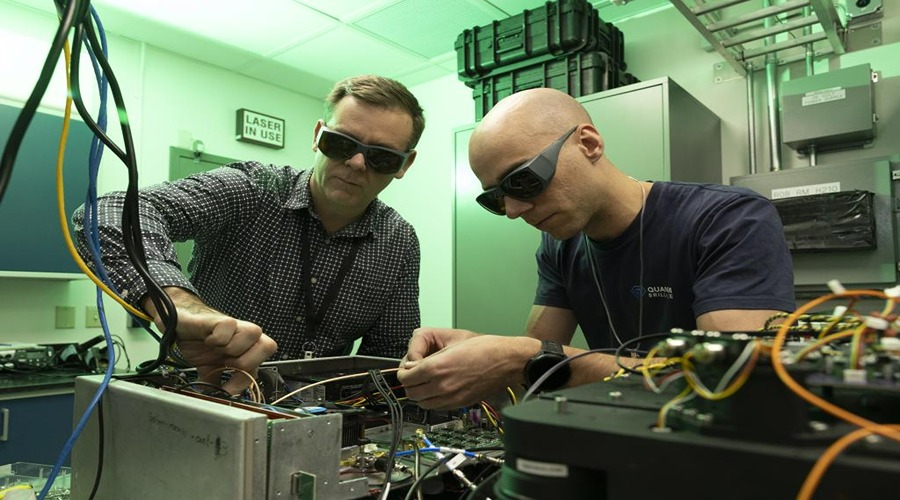
“Diamond is extremely hard, so even at room temperature and atmospheric pressure, there isn’t sufficient thermal energy to generate the vibrations that would typically disrupt qubit coherence,” he added. “This intrinsic stability allows our QPUs to function without the complexity and cost of cryogenics, laser and vacuum systems. This allowed us to engineer a revolutionary QPU solution that operates efficiently at room temperature while dramatically reducing size, weight and power consumption.”
In collaboration with the OLCF, Quantum Brilliance explores a future in HPC when QPUs can be used to accelerate tasks as GPUs do today.
“We expect the OLCF will use our system to test different architectures and methods for hybrid and parallel quantum computing, including demonstrating applications in computational chemistry and machine learning that benefit from parallelization,” said Quantum Brilliance chief technology officer Dr. Marcus Doherty. “This collaboration will help inform the engineering pathway to the future of HPC where there are hundreds of parallel quantum computers integrated with classical computers.”
Source: ORNL
About Oak Ridge National Laboratory

Oak Ridge National Laboratory (ORNL) is the U.S. Department of Energy science and energy laboratory, focused on delivering scientific discoveries and technological innovations in materials science, nuclear science, energy production, cybersecurity, and artificial intelligence. Established in 1943 as part of the Manhattan Project, ORNL has over 80 years of expertise and is headquartered in Oak Ridge, TN. It serves industries such as energy, defense, transportation, healthcare, and advanced manufacturing. ORNL offers research facilities and houses the Frontier supercomputer. The lab plays a critical role in advancing clean energy solutions, national security technologies, and next-generation materials development. Its operating budget exceeds $2 billion annually, funded primarily through federal agencies. ORNL collaborates globally with industry, academia, and government to accelerate innovation and solve complex scientific and engineering challenges.
About Quantum Brilliance

Quantum Brilliance, founded in 2019, develops room-temperature diamond quantum accelerators for use outside cryogenic environments. Headquartered in New South Wales, Australia, with offices in Germany, Singapore and the United Kingdom, the company serves sectors such as data centers, autonomous systems, research and sensing. Its hybrid platform integrates a quantum processing unit with graphics processing and central processing units to support parallel and hybrid quantum-classical workflows. Quantum Brilliance focuses on making quantum technology practical for computing systems and devices. The company has partnerships in North America, Europe and the Asia Pacific with governments, supercomputing centers, research organizations and industry partners. Its estimated annual revenue is about $46.4M.
