

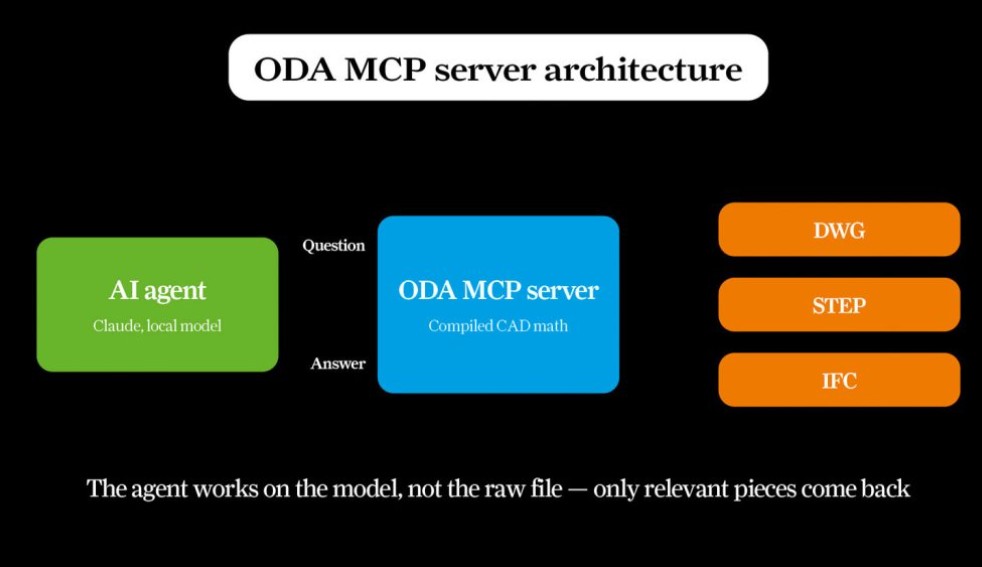
The Open Design Alliance (ODA) is preparing to make its CAD and BIM software development kits accessible to AI agents through a new set of self-hosted Model Context Protocol (MCP) servers. The move represents a significant shift for the nonprofit consortium, whose technology has quietly powered hundreds of engineering applications for more than 25 years. Rather than serving only software developers, ODA now aims to make its engineering toolset directly available to architects, engineers, contractors, and other professionals through natural language AI interfaces, reports AEC Magazine.
ODA’s SDKs support widely used engineering file formats, including DWG, DGN, IFC, STEP, and Revit. Traditionally, developers integrated these libraries into their own applications to read, write, visualize, and manipulate engineering models. With the introduction of MCP servers, AI agents such as Claude will be able to interact directly with the same underlying functionality without requiring users to write code. Instead of parsing complex CAD files themselves, AI systems will query the ODA server for precise geometric, structural, or property data, ensuring accurate and consistent responses generated by the same compiled C++ engine used in commercial software.
Early demonstrations illustrate the technology’s potential. In one example, an AI agent generates a mountain road across real terrain, creates a DWG model, and produces a technical PDF report without human intervention. Another demonstration shows an AI inspecting a mechanical part, taking measurements, adding a hole feature, and updating the engineering drawing. Initial support includes DWG, STEP, and IFC, with DGN, Revit, and Navisworks planned for future releases.
The self-hosted architecture is central to ODA’s strategy. Organizations can deploy MCP servers within their own infrastructure, allowing AI to analyze sensitive BIM and CAD data without transferring project files to external cloud services. This approach supports AI sovereignty while enabling firms to build custom AI assistants that can answer technical questions, extract quantities, compare design revisions, identify missing information, and check compliance against project standards.
Although challenges remain, particularly around full Revit write-back capabilities, ODA believes its model-agnostic, member-governed platform offers a durable foundation for AI-driven engineering workflows. By exposing trusted CAD and BIM tools directly to AI agents, the alliance is positioning itself as a neutral data access layer that could reshape how engineering professionals interact with design information in the years ahead.
