

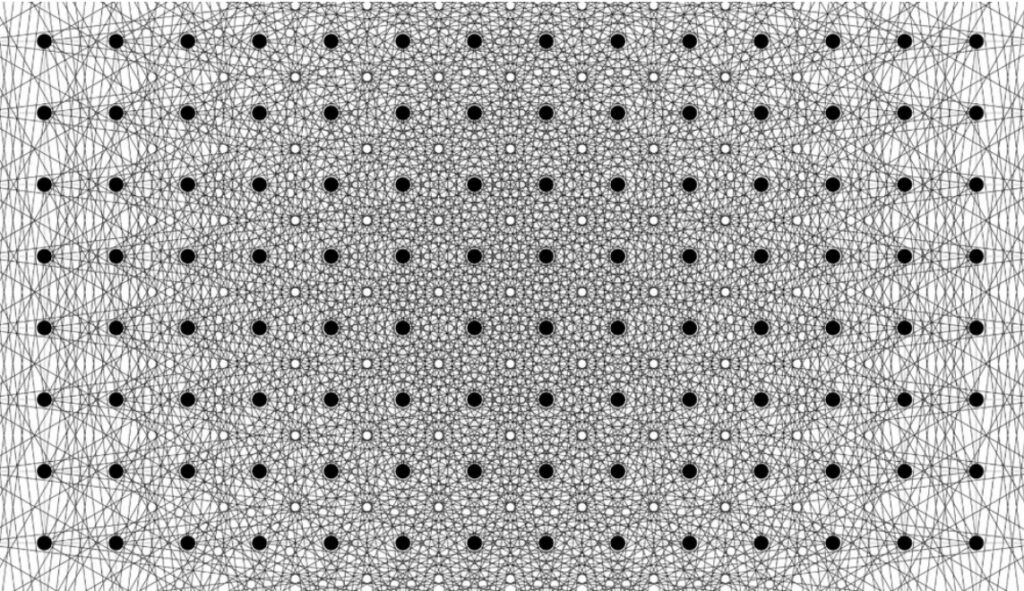
A recent breakthrough has demonstrated the growing potential of artificial intelligence as a tool for mathematical discovery. OpenAI researchers revealed that an internal AI reasoning model helped solve a complex combinatorial problem that had remained unsolved for approximately 80 years. The result was subsequently verified by professional mathematicians, marking a notable example of AI contributing to original mathematical research rather than simply assisting with calculations or proofs, tells Live Science.
The problem involved a question in extremal combinatorics, a branch of mathematics that studies the limits and structures of discrete systems. Researchers tasked the AI model with exploring possible solutions and generating novel lines of reasoning. Unlike traditional mathematical software, which follows predefined algorithms, the model was able to examine numerous possibilities, identify promising patterns, and propose approaches that had not previously been considered by human researchers.
According to the report, the AI generated insights that led mathematicians toward a proof of the conjecture. Human experts then carefully checked the reasoning and validated the result using established mathematical methods. The researchers emphasized that the AI did not independently publish a proof or replace mathematicians. Instead, it functioned as a powerful collaborator capable of suggesting creative ideas and uncovering hidden connections within a difficult problem space.
The achievement highlights an emerging trend in which advanced AI systems are moving beyond routine automation and becoming partners in scientific discovery. Mathematical research is often viewed as a uniquely human activity because it requires intuition, abstraction, and creative problem-solving. The successful resolution of a decades-old problem suggests that AI may increasingly assist researchers in fields where innovation depends on generating new ideas rather than processing existing information.
While experts caution that AI-generated results still require rigorous human verification, the accomplishment demonstrates the technology’s growing ability to contribute to fundamental research. As AI reasoning models continue to improve, they could become valuable tools for mathematicians, physicists, engineers, and scientists tackling problems that have resisted conventional approaches for decades.
