

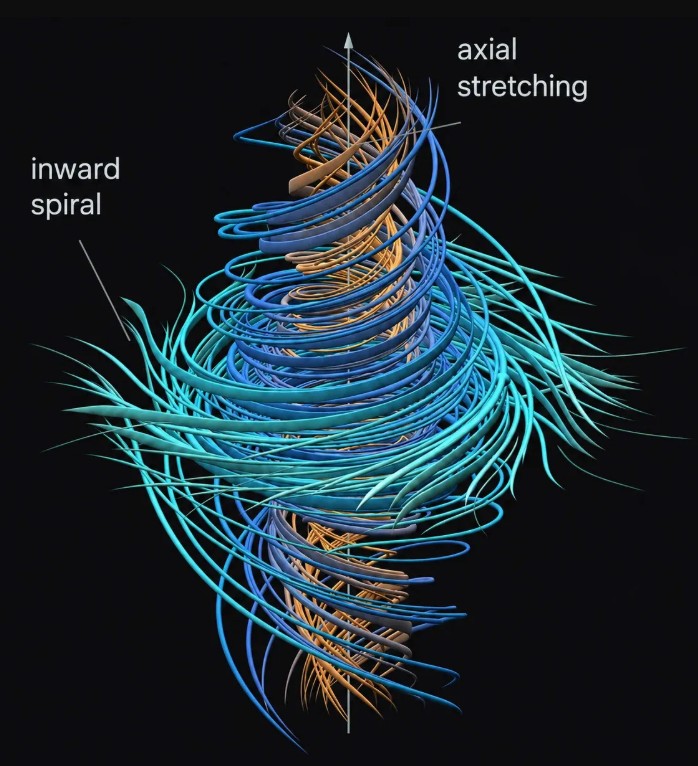
OpenAI says its AI agents have solved an outstanding problem connected to the Navier-Stokes equations, but the announcement has triggered a dispute over how the company reached its result. The equations describe fluid motion and underpin applications ranging from aerodynamics to weather forecasting. Proving whether certain solutions can develop singularities remains part of a Millennium Prize Problem carrying a $1 million award, says Live Science.
OpenAI reportedly deployed about 10,000 AI agents for 88 hours. The system first investigated the related Euler equations and found blowups using smooth forcing, an approach that applies controlled external influences to a simulated fluid. OpenAI then pursued the Navier-Stokes problem and used the Lean theorem prover to check its mathematical argument. The effort generated 2.7 million messages and about 130 billion output tokens.
The controversy centers on mathematicians Tristan Buckmaster of New York University and Levent Alpöge of Anthropic. They had independently been investigating smooth forcing and achieved results for the Euler equations before OpenAI announced its work. Buckmaster argues that the approach was unusual enough that OpenAI’s rapid adoption of it raised questions about where the idea originated.
A further concern involves Buckmaster’s use of OpenAI Codex while developing drafts. He asked whether information from those sessions could have contributed to OpenAI’s models. OpenAI said its employees and agents did not see the researchers’ work before public release, although the company said it could not exclude the possibility that de-identified product-use data had helped improve its models. OpenAI representatives have disputed other allegations surrounding the episode.
The mathematical result itself remains unsettled. OpenAI’s proof still requires formal peer review, and the Clay Mathematics Institute has not confirmed it as a solution. The dispute therefore raises a broader issue: as AI becomes capable of accelerating advanced research, scientists may need clearer rules governing data use, authorship, attribution, and priority.
