

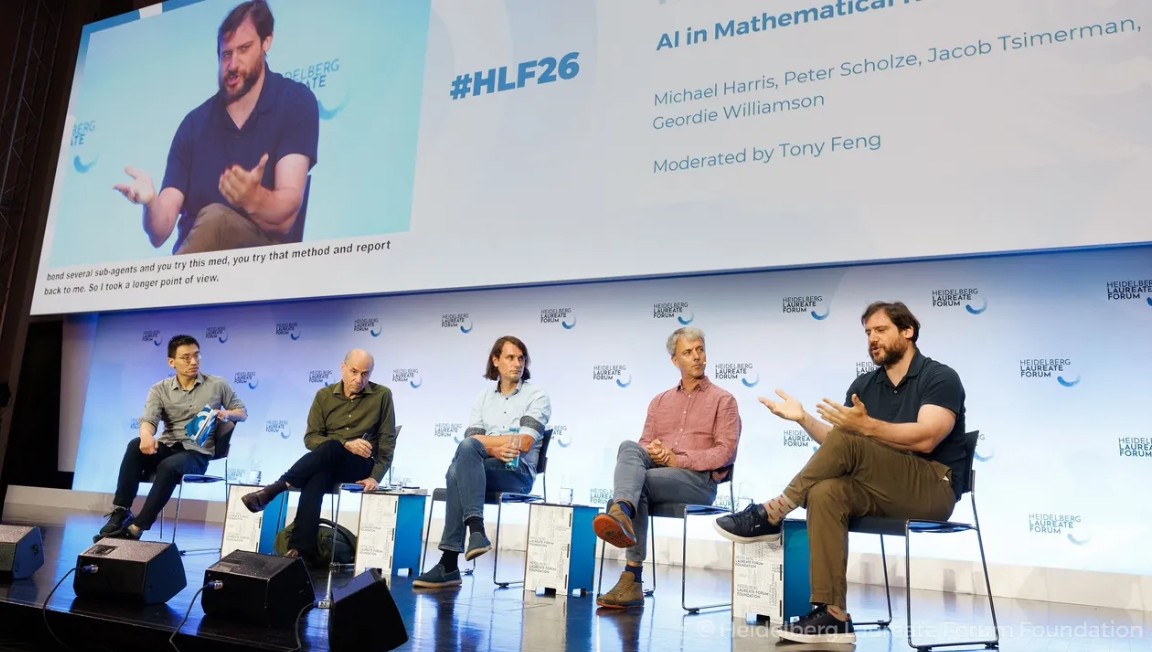
OpenAI’s claim that 10,000 AI agents solved the Navier-Stokes existence-and-smoothness problem has sparked a dispute over research ethics and the purpose of mathematics. Live Science reports on the debate at the Heidelberg Laureate Forum, where mathematicians offered sharply different views of AI’s growing role.
Tristan Buckmaster and Levent Alpöge allege that OpenAI learned about their ongoing research, rushed to beat them to publication, and discouraged them from speaking publicly. Columbia University mathematician Michael Harris criticized the company’s conduct and called for protections against actions that undermine the mathematical community.
Jacob Tsimerman, a Fields Medalist who joined OpenAI as an AI safety researcher, emphasized the claimed achievement. He suggested that AI could diminish the role of humans conducting frontier research while creating an abundance of new mathematics to explore.
Peter Scholze disagreed with that emphasis. He argued that solving famous problems matters because the methods can illuminate related questions and deepen human understanding. A lengthy machine-generated proof, he suggested, may contribute less to that goal than its headline achievement implies.
The Clay Mathematics Institute’s announcement reinforces the importance of understanding. Established in 2000, its seven Millennium Prize Problems each carry a $1 million award. The Navier-Stokes challenge concerns the existence and smoothness of solutions describing fluid motion in three dimensions. The institute welcomed the apparent breakthrough but said evaluating achievement and assigning credit would follow its unhurried process. An announcement therefore differs from a completed prize evaluation.
Meanwhile, the Association for Human Mathematics advocates protecting independent scholarship and preserving expertise developed through writing and careful thought. It warns that automated mathematics can weaken education, strain journals, and reduce opportunities for students to build deep understanding. Its response centers on collective action and policy proposals. The debate concerns who benefits from mathematical discovery and whether faster results also produce meaningful human insight.
