

Bentley’s OpenPlant 2026 targets the obstacles that slow industrial plant design: repetitive tasks, scattered project information, coordination difficulties, and sluggish performance in large models. The release combines AI assistance with improvements to collaboration, drawing production, data exchange, and modeling speed, tells Bentley.
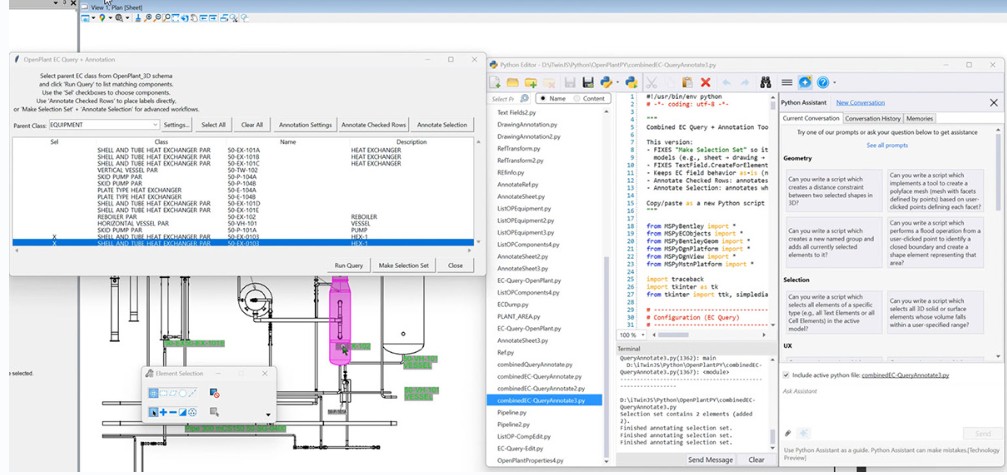
Python Assistant brings natural language automation to OpenPlant Modeler. Built on MicroStation’s scripting foundation, it allows users to create reusable workflows for reporting, data extraction, component placement, equipment creation, and model updates. Bentley presents the tool as a way to make automation accessible and standardize processes that require manual work.
Bentley Copilot focuses on learning and workflow guidance. Users can ask questions within the application and receive contextual documentation and step-by-step instructions. This could help new designers become productive sooner, particularly those moving from AutoCAD-based workflows, while reducing time spent searching for help outside the design environment.
Performance improvements address the demands of large, multidisciplinary projects. OpenPlant Modeler offers faster check-in and update operations, better responsiveness during component-based modeling, and refinements to synchronization when working with reference data. Enhanced locking capabilities support collaboration in shared project environments and help reduce access bottlenecks.
Bentley Raceway and Cable Management also receive upgrades. These include faster Cable Manager loading, quicker routing model refreshes, accelerated automatic cable routing, and faster saving of routing results.
For project deliverables, the release improves the stability, consistency, and usability of isometric drawing production. Interoperability updates support more reliable migration of older AutoPLANT projects. Improved IFC exports automatically include OpenPlant schemas and project data, helping stakeholders exchange information across software platforms.
Reality context enhancements let teams incorporate two-dimensional and three-dimensional map data into their design environment, providing better spatial context for coordination and decisions. Together, these changes position OpenPlant 2026 as a practical productivity update for engineering teams managing complex facilities, distributed contributors, and demanding delivery schedules and budgets.
