

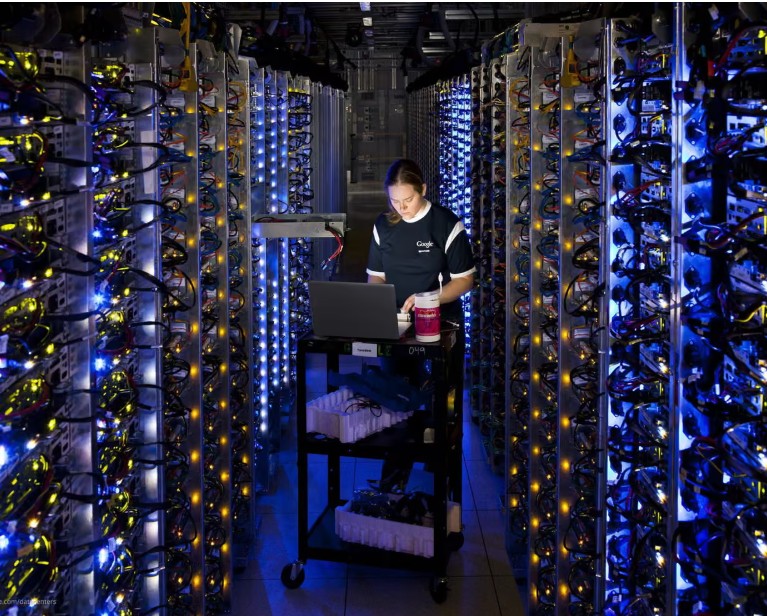
Google’s “Project Suncatcher” envisions constellations of roughly 80 solar-powered satellites orbiting about 400 miles (≈640 km) above Earth, each carrying AI-focused hardware such as Tensor Processing Units (TPUs) and linked via free-space optical (laser) communications, tells The Guadian.
The driving logic: data centers on Earth are hit by cooling, land-use, and water-consumption constraints. In orbit, solar panels can deliver up to eight times more productivity than ground-mounted ones, and land and water demands would drop dramatically.
Google plans to launch two prototype satellites by early 2027 and estimates that by the mid-2030s, launch costs might fall to a level where space-based data centers approach cost parity with terrestrial ones.
However, the initiative is laden with engineering and environmental challenges. Thermal management in space, high-bandwidth ground links, radiation-hard hardware and orbital debris each pose serious hurdles. Astronomers also warn of the risk of satellite constellations interfering with observations—“bugs on a windshield” in their words.
From a strategic angle, this move reflects the unprecedented compute demand of AI models and the growth pressure on data center infrastructure globally. AI firms are facing a multitrillion-dollar build-out of compute, and space offers a potential next frontier.
Google’s space-based AI data center proposal blends ambition with complexity. It signals a shift in thinking: compute architecture may leap from Earth’s surface to orbit, but success will require navigating physics, launch economics, network architecture, and regulatory terrain.
