

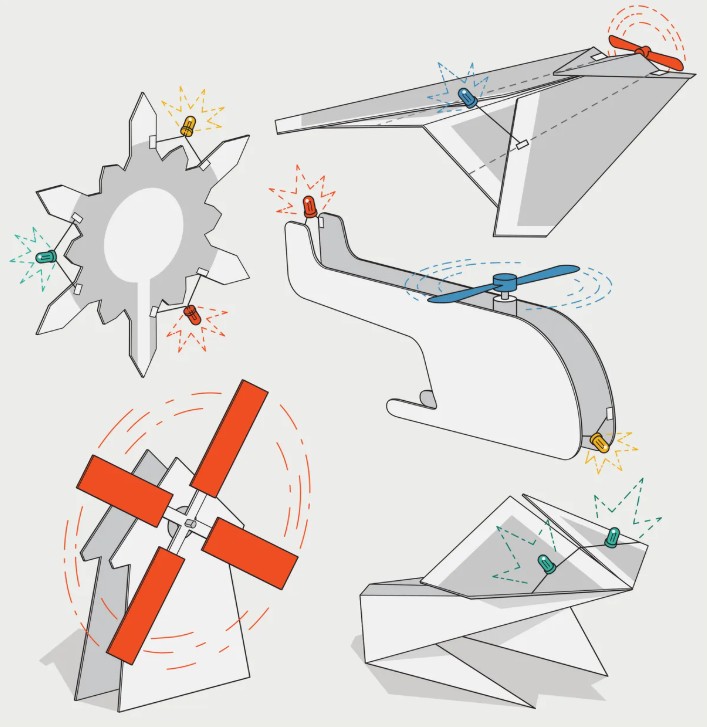
Researchers have developed a simple but inventive way to build electronic circuits by combining origami with conductive materials, opening the door to inexpensive, customizable, and three-dimensional electronic devices. The IEEE Spectrum article describes a fabrication technique that transforms paper into functional circuit boards by impregnating it with conductive liquid ink, allowing electrical traces to be formed through carefully planned folds rather than traditional printed circuit board manufacturing.
The process begins with paper treated with a conductive ink that penetrates the material rather than remaining on the surface. Once the paper dries, it retains its flexibility while becoming electrically conductive. Engineers then cut and fold the paper into predefined origami patterns, creating three-dimensional structures that incorporate electrical pathways without requiring separate wiring or rigid circuit boards. This approach merges centuries-old paper-folding techniques with modern electronics manufacturing, resulting in lightweight and inexpensive prototypes.
Unlike conventional printed circuit boards, which require specialized fabrication equipment and multiple manufacturing steps, the origami method simplifies production and enables rapid experimentation. Designers can integrate LEDs, motors, sensors, and other electronic components into folded paper structures, producing interactive objects such as illuminated decorations, moving paper toys, educational models, and simple robots. Because the circuits are embedded within the folded material, the final devices are compact and mechanically integrated.
The technique also offers educational benefits. Students can learn electronics, circuit design, and mechanical engineering simultaneously by building functional devices with familiar materials. The low cost of paper and conductive ink makes the technology accessible for classrooms, makerspaces, and hobbyists while encouraging experimentation that would be impractical with traditional PCB fabrication.
Although paper-based circuits are not intended to replace commercial printed circuit boards in demanding applications, they demonstrate an alternative approach to rapid prototyping and creative product design. Researchers continue to refine the materials and folding techniques to improve durability and electrical performance. By combining origami principles with conductive materials, the work illustrates how traditional crafts can inspire practical engineering solutions, expanding the possibilities for low-cost electronics, educational tools, wearable devices, and interactive paper-based technologies.
