

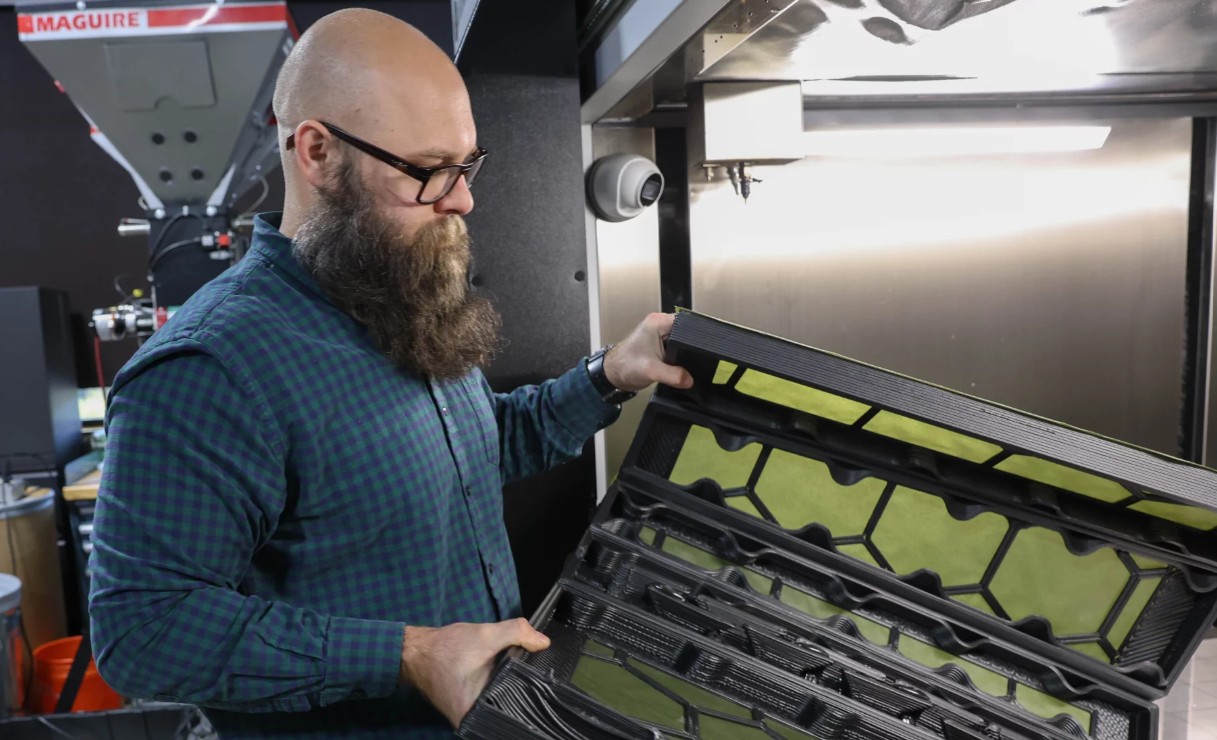
Researchers at the U.S. Department of Energy’s Oak Ridge National Laboratory have developed an origami-inspired hybrid 3D printing process that could transform the way composite structures are manufactured, tells New Atlas. Instead of relying on expensive molds to create complex components, the new technique produces flat panels that can be folded into three-dimensional shapes after printing. By combining additive manufacturing with principles borrowed from the Japanese art of origami, the approach offers manufacturers a faster, more flexible, and significantly less expensive alternative to conventional composite fabrication.
Traditional composite manufacturing produces strong and lightweight parts but often requires custom molds that are costly to design, build, and store. The new process eliminates those molds entirely. Engineers print a structural grid directly onto a flexible fabric base, such as nylon or glass fiber, using carefully selected thermoplastic or thermoset materials. A bonding layer ensures that the printed grid and the fabric fuse at the molecular level, creating a single integrated component that remains lightweight yet structurally strong. Once printed, the flat panels are folded into their final shapes, enabling designs that would be difficult or impractical with conventional manufacturing.
The researchers report substantial manufacturing gains. Producing a unique composite part with the mold-free process reduced fabrication time by about 95% and manufacturing costs by roughly 90% compared with traditional mold-based methods. Because the components are printed flat, manufacturers can also fabricate structures larger than the build volume of the printer itself while eliminating the need to store bulky molds. These advantages could benefit industries such as aerospace, automotive, construction, and defense, where lightweight composite structures are increasingly in demand.
The research team has filed a patent and is preparing the technology for commercial licensing. Their long-term goal is to make the process scalable across multiple industries, allowing manufacturers to produce complex, foldable composite structures with greater efficiency and lower costs. By merging material science, additive manufacturing, and origami-inspired engineering, the innovation expands the possibilities for designing large, lightweight structures while simplifying production workflows.
