

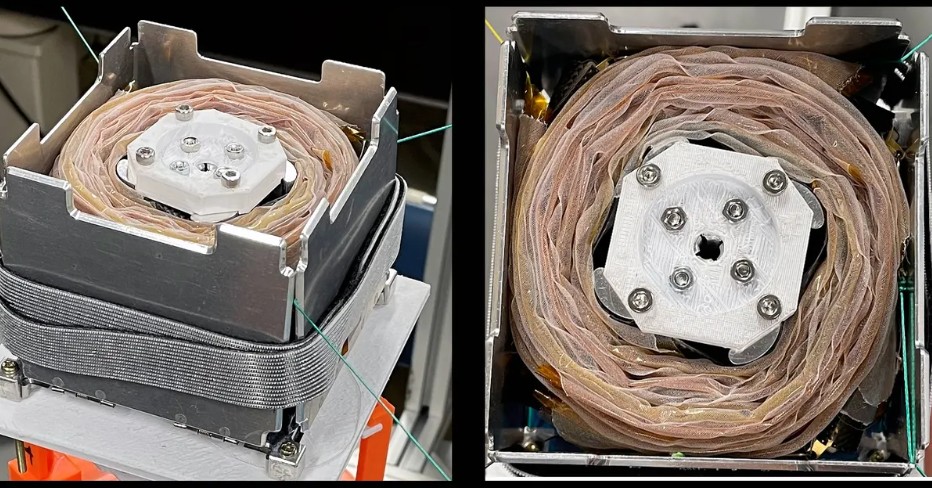
CubeSats have transformed access to space by offering a low-cost, compact platform for scientific research, Earth observation, and communications. However, their small size imposes significant limitations, particularly when it comes to antennas. High-gain antennas are essential for transmitting large amounts of data across long distances, yet conventional designs often require more space than CubeSats can provide. A new origami-inspired antenna concept aims to overcome this challenge by combining compact storage with large deployed performance, says IEEE Spectrum.
The design centers on a foldable reflectarray antenna that can be packed into the tight confines of a CubeSat during launch and then expanded once in orbit. Reflectarrays combine characteristics of traditional parabolic dishes and phased-array antennas. Rather than using a curved reflector, they employ a flat surface covered with carefully engineered elements that redirect radio waves into a focused beam. This approach reduces weight and complexity while maintaining strong communication performance.
Researchers drew inspiration from origami principles to create a structure that folds efficiently without damaging sensitive antenna components. Once deployed, the antenna unfolds into a much larger surface area than would otherwise fit inside the satellite. The larger aperture improves signal strength, increases data transmission rates, and enhances communication links between spacecraft and ground stations.
The technology could have broad implications for future small-satellite missions. Earth observation platforms generate increasingly large volumes of data that must be transmitted back to Earth. Scientific missions operating farther from the planet also require stronger communications systems. By enabling CubeSats to carry larger antennas without sacrificing launch efficiency, the foldable reflectarray could expand the range of missions these spacecraft can perform.
The development reflects a growing trend toward applying mechanical design innovations to space engineering challenges. Rather than increasing satellite size and cost, engineers are finding ways to create structures that transform after launch. Foldable solar panels, deployable booms, and now origami-inspired antennas demonstrate how compact spacecraft can achieve capabilities once reserved for much larger systems.
As satellite constellations continue to grow and demand for data transmission increases, deployable antenna technologies such as this reflectarray may become a key component of next-generation CubeSat architectures, enabling more powerful and versatile missions while preserving the cost advantages of small spacecraft.
