

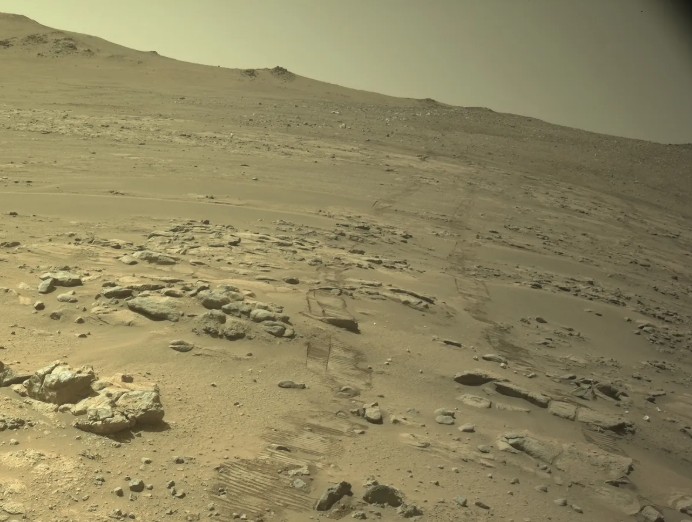
NASA’s Perseverance rover has set a new distance record on Mars, traveling 45.22 kilometers, or 28.10 miles, as of October 11, 2026. The milestone puts it ahead of Opportunity, which covered 45.16 kilometers during its 15-year mission. Perseverance achieved the record in about five years, largely because of advances in autonomous navigation, tells IEEE Spectrum.
Autonomy has been part of Mars exploration since Sojourner in 1997, but Perseverance represents a major step forward. Spirit drove autonomously about 23% of the time, while Opportunity and Curiosity used autonomous driving for roughly 5% of their travels. Perseverance drives itself about 90% of the time.
Its AutoNav system uses onboard cameras and computing to assess terrain, detect hazards, and select safe paths while traveling at speeds of up to 120 meters per hour. Human teams still determine long-range destinations and identify dangerous regions using orbital imagery. The rover then handles much of the local navigation independently.
This division of work is important because orbital images cannot reveal every rock, slope, or surface hazard. Perseverance has also encountered terrain that exceeded its original autonomous capabilities. When leaving the relatively flat Jezero Crater, engineers adjusted its software to handle rockier ground and slopes reaching 24 degrees.
Artificial intelligence is beginning to contribute to route planning as well. In a recent experiment, Anthropic’s Claude analyzed orbital imagery and proposed a route for a 400-meter drive. Human planners reviewed and modified the AI-generated path before using it.
NASA has also added Mars Global Localization, which reduces uncertainty about the rover’s position during long drives. Combined with efforts to automate scientific observations, the technology could eventually allow future planetary rovers to operate independently for extended periods. Perseverance’s distance record therefore reflects more than mechanical endurance. It demonstrates the growing role of autonomy in exploring environments where constant human control is impractical.
