

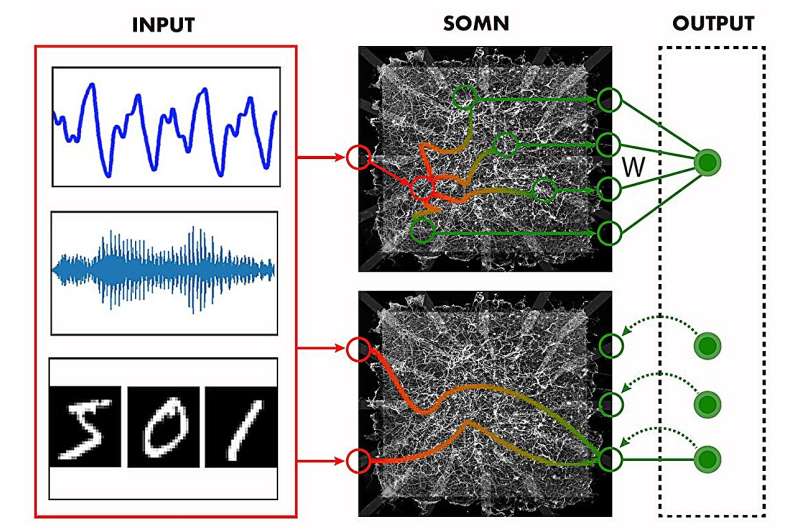
Researchers at the University of California, Los Angeles (UCLA), and international collaborators are advancing a computing approach in which physical materials perform neural network functions directly. Instead of running AI software on conventional processors, these systems use self-organizing networks of nanowires or nanoparticles that adapt their electrical connections in response to incoming information, tells Tech Xplore.
The research, reviewed in Nature Reviews Physics, addresses growing concerns about the energy and infrastructure demands of conventional AI. It also explores opportunities for intelligent devices operating with limited power, connectivity, and computing resources.
Inspired by the brain’s cortex, these networks process information through changing physical connections. Nanowires and nanoparticles function similarly to neurons, while their electrical connections resemble synapses. Repeated stimulation strengthens connections, creating memory-like behavior, while unused connections gradually weaken.
Researchers have demonstrated the ability of these networks to perform machine-learning tasks, including speech and image recognition, by exploiting their physical properties rather than executing conventional neural network software.
The technology could prove valuable for edge computing, where information must be processed close to its source. Satellites, for example, generate enormous datasets but face restrictions on transmission bandwidth. Self-organizing networks could help filter and process information locally, reducing dependence on remote computing infrastructure.
Two approaches underpin the research: nanowire networks introduced by UCLA in 2011 and nanoparticle networks developed by researchers including Simon Brown at the University of Canterbury in 2013.
UCLA researchers Adam Stieg and James Gimzewski have contributed to developing this computing platform, alongside collaborators including University of Sydney physicist Zdenka Kuncic.
Although inspired by biological intelligence, the researchers emphasize that their objective is not to reproduce the human brain. Instead, they aim to incorporate useful biological principles into engineered materials.
The findings suggest a future in which computation, learning, and physical adaptation become integrated within hardware, potentially supporting autonomous, low-power intelligent systems alongside conventional silicon computers.
