

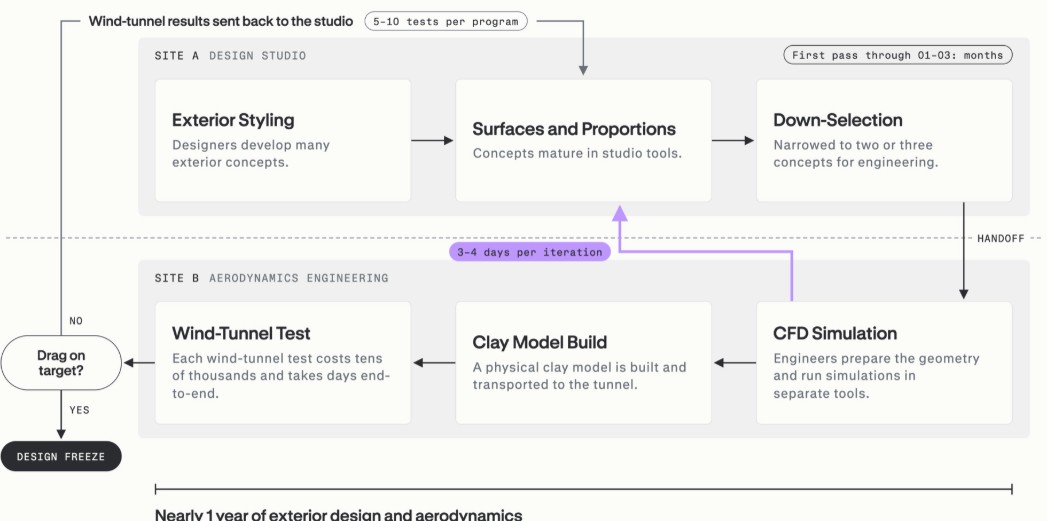
Automotive designers often define a vehicle’s proportions and surfaces before receiving aerodynamic feedback, creating costly iterations when engineering analysis reveals performance problems. Luminary describes how one global automotive OEM is using Physics AI to bring aerodynamic guidance directly into the design process.
Previously, the OEM’s design studio selected one or two concepts before sending them to an aerodynamics team at another location. Each design-change iteration required three to four days for aerodynamic feedback. Exterior design and aerodynamic refinement could consume nearly a year of a three-to-four-year vehicle program, while 5 to 10 wind-tunnel tests added physical modeling and engineering work.
Luminary and the OEM created a virtual wind tunnel inside Blender to shorten this cycle. Designers can modify vehicle geometry and receive aerodynamic predictions in one to three seconds without leaving their design environment or preparing models for a separate simulation workflow.
The underlying Large Physics Model was trained on approximately 4,000 high-fidelity simulations for the relevant vehicle class. On a held-out validation set, its predictions achieved approximately 1 percent mean error compared with CFD results.
Confidence metrics play an important role. When a design resembles geometry represented in the training data, the system predicts drag, surface pressure, and wall shear stress. If geometry falls outside the model’s training distribution, it flags the prediction as low confidence instead of presenting potentially unreliable results.
Designers can then launch high-fidelity CFD directly from Blender, with results available within minutes. Those simulations are added to the training dataset and used to improve subsequent versions of the model.
The workflow changes aerodynamics from a downstream validation step into continuous design guidance. Designers can evaluate more alternatives earlier, while CFD specialists concentrate on unfamiliar or critical geometries. Physical wind-tunnel testing can then focus on stronger candidates, potentially reducing late-stage redesign and accelerating vehicle development.
