

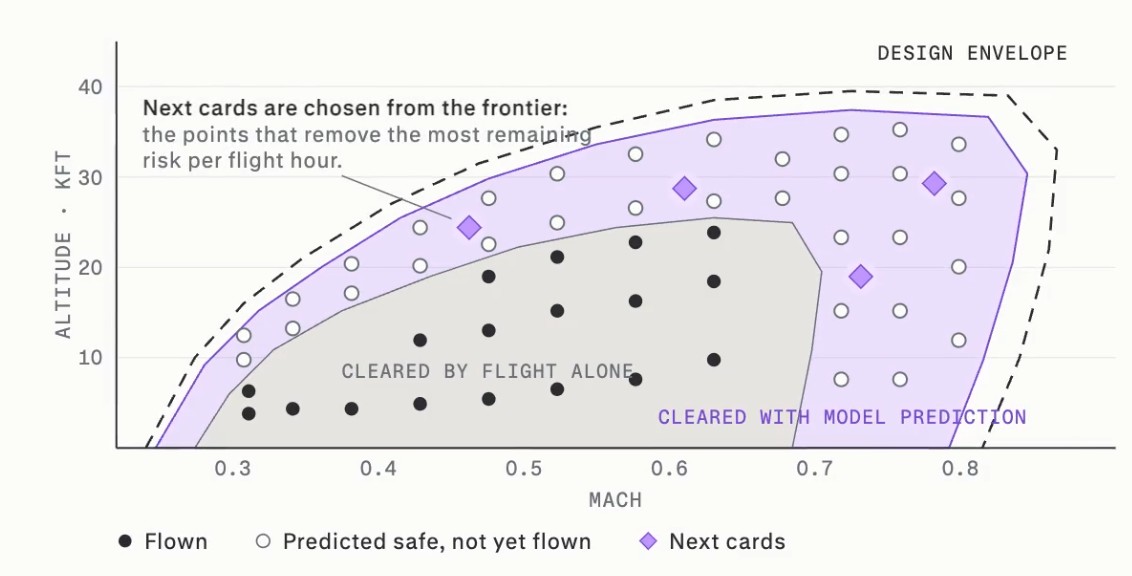
Flight testing is one of the most expensive and time-consuming stages of aircraft development. Luminary examines how DARPA’s CyPhER Forge program aims to use Physics AI to reduce the number of flight-test points needed to characterize aircraft behavior by a factor of 10.
The approach centers on Large Physics Models, AI models trained on physics simulation data. Rather than relying only on individual flight measurements, these models can predict aircraft behavior across a wider range of operating conditions. When grounded in real flight data and paired with validated uncertainty estimates, they could help engineers determine where another physical test would provide the most useful information.
This creates what Luminary describes as a learning digital twin. After each maneuver, new measurements update the aircraft model. Engineers can then examine discrepancies between predicted and observed behavior and decide whether they need another maneuver, repeated measurements, or an instrumentation check.
Speed is critical. DARPA’s Phase 2 objectives call for predictions in less than one-tenth of a second and model updates in less than a minute. This could allow insights from one maneuver to influence subsequent testing during the same flight.
Reliable uncertainty quantification is equally important. The system must distinguish gaps in the model’s knowledge from sensor noise and changing flight conditions. Out-of-distribution detection can also flag predictions outside the model’s validated operating region.
Luminary’s SHIFT models illustrate the underlying Physics AI approach by using existing simulation data to make rapid predictions across operating conditions. The company is also exploring ways to anchor such models to physical measurements.
The objective is not to eliminate required safety, verification, or certification testing. Instead, Physics AI could help engineers select higher-value test points, avoid unnecessary repetition, and extract more engineering knowledge from every flight.
