

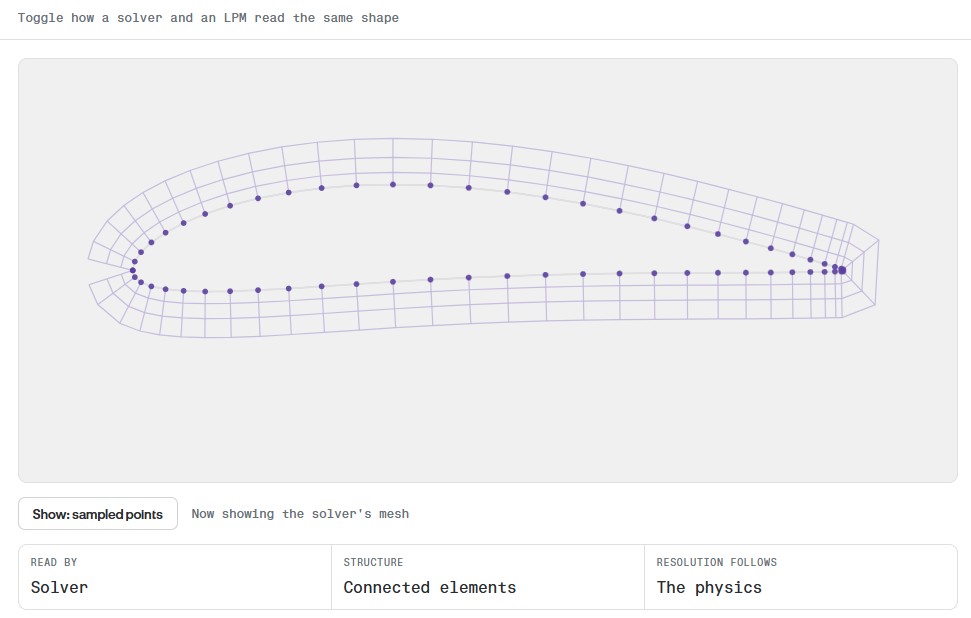
Luminary explains a fundamental challenge facing Physics AI: before an AI model can predict airflow, pressure, or other physical behavior, it must understand the geometry it is analyzing. The article examines how Large Physics Models, or LPMs, gain the spatial context needed to recognize engineering features and their influence on physics.
Traditional numerical solvers interpret geometry through meshes designed to solve governing equations. LPMs work differently. They learn relationships between geometry, operating conditions, and resulting physical behavior. This enables them to generate predictions in seconds instead of spending hours directly solving governing equations. But learning these relationships requires more than feeding individual coordinates into a neural network.
A single point provides little information about its surroundings. On an aircraft wing, for example, identical-looking points can behave differently depending on whether they belong to a leading edge, trailing edge, or flat surface. Physics AI therefore needs both local geometric information and broader spatial context.
Luminary describes two approaches for providing this information. The first gathers neighboring points around each location at several radii. Small neighborhoods reveal local details such as curvature, while larger neighborhoods help establish where the point lies on the overall body. Because neighbors are identified through physical distance, this approach does not depend on mesh connectivity. Its drawback is additional computational work during every prediction.
The second approach, positional encoding, transforms coordinates into sine and cosine functions spanning multiple frequencies. Low frequencies represent broad spatial variations, while higher frequencies help neural networks capture sharp, localized features such as pressure peaks on wings.
These techniques can complement signed distance functions, occupancy grids, and graph-based representations. Models may combine several methods, allowing each to contribute different spatial information. The result helps Physics AI connect engineering geometry with physical behavior while making its underlying methods more understandable to engineers.
