

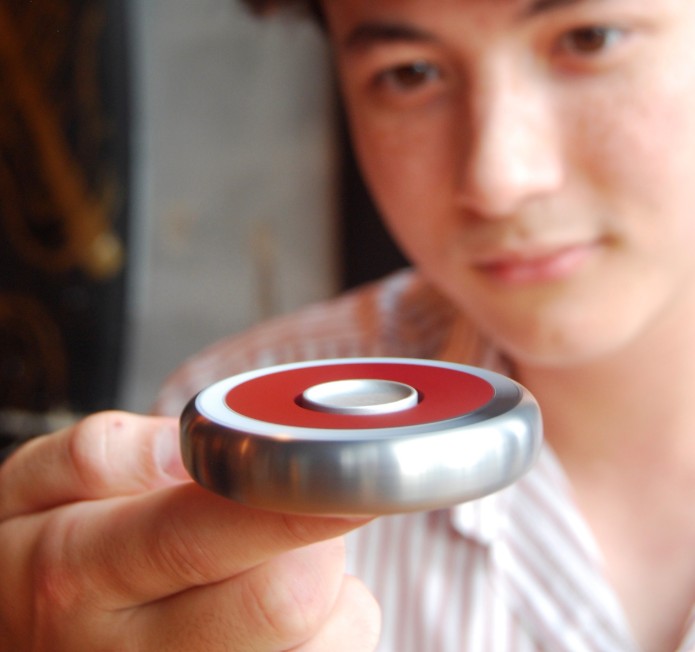
What began as a hobby in spinning tops became a record-breaking engineering project for James Goh, a Manufacturing Engineering Tripos (MET) student at the University of Cambridge. By combining physics, mathematical analysis, and precision engineering, Goh designed a fidget spinner that achieved a new Guinness World Record for the longest spin. The project demonstrates that even a simple toy can become a platform for exploring advanced engineering principles, tells this article from the University of Cambridge.
Rather than relying on trial and error, Goh approached the challenge scientifically. He analyzed the factors that influence rotational performance, including mass distribution, rotational inertia, friction, and aerodynamic drag. Using mathematical models, he identified the optimal balance between weight and geometry to maximize spin duration. Every design decision was guided by calculations that predicted how the spinner would behave under real operating conditions.
The engineering process extended to manufacturing. Goh selected high-quality materials, precision bearings, and carefully machined components to minimize energy losses caused by friction and imbalance. Tight manufacturing tolerances ensured that the spinner rotated smoothly and efficiently, allowing it to retain angular momentum far longer than conventional designs. The final product represented a combination of theoretical analysis and meticulous craftsmanship.
The project also highlights the educational value of applying classroom concepts to real-world design challenges. Principles from mechanics, materials engineering, manufacturing, and product design all contributed to solving a practical problem. By iterating through design calculations, prototypes, and testing, Goh demonstrated the same engineering workflow used to develop high-performance industrial products, albeit on a much smaller scale.
Beyond earning a Guinness World Record, the achievement illustrates how engineering is often driven by curiosity and experimentation. A familiar consumer object became an opportunity to investigate rotational dynamics, optimize mechanical performance, and validate theoretical models through physical testing. The project serves as a reminder that innovation is not limited to complex machines or large-scale systems. Even an everyday object can inspire meaningful engineering research when approached with analytical thinking and careful design. Goh’s record-breaking spinner showcases the power of combining scientific principles with precision manufacturing to push the limits of what appears to be a simple device.
